Showing posts with label Mains 2017. Show all posts

Saturday, 4 November 2017

GEOGRAPHY PAPER II 2017 UPSC

SECTION A 

  1.  (a) On the outline map of India provided to you, mark the location of all of the following. 

    Write in your QCA Booklet the significance of these locations whether physical/commercial/economic/ecological/environmental/ cultural in not more than 30 words for each entry:

     i. Thumba
    ii. Nayachar Island
    iii. Doddabetta
    iv. Devasthal
    v. Pangong Lake
    vi. Hampi
    vii. Havelock Island
    viii. Luni River
    ix. Daringbadi
    x. Dudhsagar Waterfalls


    (b) Give a reasoned account of unusual pattern of distribution of monsoonal rainfall in India in 2017. 

    (c) Explain the inter-state involved in implementation of the Satluj-Yamuna Link Canal Project.

    (d) Small towns in India have problems and prospects of their own. Elaborate.


  2. (a) Discuss the freshwater crisis in India and prepare a blueprint for as sustainable management. 20

    (b) Identify the Naxal-affected areas in India and discuss their social problems. 15

    (c) Critically examine the feasibility of development of a comprehensive network of airways in India. 15


  3.  (a) “An effective three-tier Panchayat Raj System will strengthen the bottom-up approach to multilevel planning in India.” Explain. 20

    (b) “Linguistic diversity is an asset as well as a challenge in India.” Explain the statement focusing on the distribution of languages and the major steps taken to address the related issues. 15

    (c) How may tourism in hilly areas of India be developed as an important source of economy. 15


  4.  (a) Mention various methods of functional classification of towns in India and explain the method applied by Ashok Mitra. 20 Marks

    (b) Farmer’s suicide is one of the major agrarian problems in India. Bring out its causes and suggest the remedial measures with special reference to Maharashtra, Andhra Pradesh. 15 Marks

    (c) Land reform is a key to modern agriculture in India. Describe various measures taken in this direction after Independence. 15


    SECTION B

  5. . Answer the following questions in about 150 words each: 10 x 5 = 50

    (a) Explain the role of `Hill Transport Subsidy Scheme’ in reducing regional imbalance in areas identified by the Government of India.

    (b) Bring out the geopolitical implications of Doklam dispute in the context of Indo-China relations.

    (c) Bring out the significance of Indian Regional Navigation Satellite System (IRNSS).

    (d) Mini steel plants can act as an instrument of decentralization of iron and steel industry in India. Explain.

    (e) Goods and Service Tax (GST) has differential impact on developed and backward States of the country. How and why?

  6.  (a) Interlinking of rivers may serve as a major source of assured irrigation and all weather inland navigation in India. Comment on its feasibility taking into account physical, economic and ecological implication. 20

    (b) Religious minorities are largely concentrated in border States of India Discuss its causes and consequences. 15

    (c) What do you understand by soil pollution? Delineate the areas vulnerable to it in India and suggest remedial measures. 15

  7.  (a) Integrated development of road and rail networks in a complementary framework is a prerequisite for regional development. Explain with reference to North-Eastern Region of India. 20

    (b) Describe the salient features of Sagar Mala Project and highlight its role in port led development of coastal regions in India. 15

    (c) Justify the inclusion of Meghalaya in Peninsular India and discuss its vegetation and soil types. 15

  8.  (a) Name the major industrial regions of India indicating the bases of their identification. Highlight their basic problems. 20 Marks

    (b) Drainage pattern in Peninsular India is a result of its geological structure and topography. Elaborate. 15

    (c) Why has solar energy in India not been developed to desired level in spite of its high potentials? 15



SOCIOLOGY PAPER II UPSC MAINS 2017


Q1. Write short answers with a sociological perspective on the following in about 150 words each 10 x 5 =50


(a) Write a critique of the structural and functional Perspective used by M.N. Srinivas in the understanding of Indian society.

(b) Which is more significant, the principle of 'hierarchy' or the principle of ‘difference’, in intercaste relations in the present day?

(c) What are the distinct features of Islam as practiced in India, and how have they changed over time?

(d) How have the struggles against untouchability changed their forms and perspectives from Gandhian to Ambedkarite positions?

(e) Write a short note on 'changing means of production and increased rural poverty.'


Q2.(a) The main objectives of socio-religious movements during the colonial rule in India were, reforming and synthesizing. Hinduism. Write on any two such important movements. 20


(b) Discuss Yogendra Singh s thesis on Modernization of Indian Tradition and evaluate its applicability in the present day context. 20


(c) What are the changes in the cultural and structural aspects of the caste system since independence? 10


Q3. (a) Indebtedness is one of the serious issues leading to farmer’s suicides. Discuss reasons and suggest solutions.20


(b) Clarify the distinction between `household’ and `family’ and evaluate whether joint families have completely disintegrated. 20


(c) Compare the North Indian Kinship System with the South Indian Kinship System. 10


Q4. (a) Explain the concepts of `dominant caste’ and `vote bank,’ giving examples from specific regions. 20

(b) What is the nature of religious change among tribal communities? Illustrate with two examples from colonial and post independence times. 20


(c) Compare the problems of a dalit poor family living in an urban slum with a similar type of family living in a rural setting. 10


Q5. Short answers with a sociological perspective on the following, 10x5=50

(a) What are the reasons for the escalation of violence against women in the public domain?

(b) Write a. note on Education and Equality in India. 10

(c) Give an account of the problems relating to the "creamy layer". 10

(d) Do you agree that the issue of development induced imbalances that need urgent attention? 10

(e) What are the emerging concerns on women’s reproductive health? 10


Q6. (a) Discuss some of the striking issues of development induced imbalances that need urgent attention. 20

(b) Examine the impact of heritage tourism on urban socio-spatial patterns in India. 20

(c) What are the causes and solutions for the law female sex- ratio in the DEMARU States of Punjab, Haryana, Himachal and Gujarat? 10


Q7. (a) Despite gains from the women's movement and state policy of women empowerment, gender equality is far from achieved. Identify two major challenges that prevent this goal from being reached. 20

(b) To what extent does nation building depend on strengthening of pluralities in Indian society? 20

(c) Explain the issues relating to ethnicity and sub-ethnicity.


Q8.   (a) What is Cultural Revivalism ? Give some examples from performing arts, language                               dissemination and arts and crafts in recent times. 20

        (b) What, according to you, are the two fundamental axes of social discrimination in Indian                         society? Are they changing? 20

       (c) Why have we started using another category of tribes called the Particularly Vulnerable                    Tribal      Groups (PVTGs)? Why are they so called? 10


Friday, 3 November 2017

ANTHROPOLOGY PAPER I

SECTION A

1. Write notes on the following in about 150 words each 10x5=50 

(a) Bilineal and bilateral descents

(b) Difference between religion and magic

(c) Basic tenets of structural - functionalism

(d) Non-verbal communication

(e) Questionnaire


2. (a) Discuss the development of the concept of culture in Anthropology. 20

(b) Elucidate the determinants of `Kinshi terminology’ 15

(c) Discuss the different forms of preferential marriage with suitable examples from tribal societies in India. 15


3. (a) Discuss the different traditional forms of religion in tribal societies. 20

(b) Mention the characteristic features of band with suitable examples. 15

(c) With the help of appropriate examples, explain the various forms of exchange system. 15


4. (a) Explain Ruth Benedict’s patterns of culture 20


(b) Elucidate the basic characteristics of anthropological field work methods 15


(c) Critically examine the Stewardian view of neoevolutionism. 15


SECTION B


5. Write notes on the following in about 150 words each 10 x 5 = 50


(a) Hardy-Weinberg law

(b) Salient features of Mesolithic culture

(c) Concept of race

(d) Age at menarche

 (e) Anthropology and designing of equipments


6. (a) Define Anthropology. Describe the major branches of Anthropology elaborating on any one branch.5+15=20


(b) Bring out the comparative anatomical features of man and apes. Discuss their evolutionary significance. 15 (c) What are dating methods? Discuss one absolute method and one relative method in detail. 15 7. (a) Briefly describe the various methods used in the genetic study of man. 20 (c) Discuss the responses and acclimatization to high altitude stresses. 15 (b) Describe the biological and socio-ecological factors affecting fertility and mortality. 15 8. (a) What are the methods of personal identification? Critically examine how personal identification helps in criminal investigations. 20 (b) Describe the various methods of studying growth highlighting their merits and demerits. 15 (c) Discuss Sheldon’s method of somatotyping. 15

SOCIOLOGY PAPER I 2017

SECTION A 

1. (a) Explain how sociology has emerged as a distinct discipline based on rationality and scientific temper. 10

(b) Examine ethnomethodological and phenomenological perspectives as critique of positivism. 10

(c) Illustrate with example the significance of variables in sociological research. 10

(d) Critically analyse Talcott Parsons' conception of 'Pattern Variables'. 10

(e) Can we equate 'poverty' with 'poor living’? Elaborate your answer. 10


2. (a) Discuss the changing equations of discipline of sociology with other social sciences. 20

(b) Examine the basic postulates of positivism and postpositivism. 20

(c) Elaborate the main tenets of interpretative perspective in sociology. 10


3. (a) Discuss distinct sociological method adopted by Emile Durkheim in his study of `suicide'. 20

(b) Analyse Marxian conception of historical materialism as a critique of Hegelian dialectics. 20

(c) Examine epistemological Inundations of qualitative methods of social research. 10


4. (a) What is Weberian critique of Marxist notion of social stratification? 20

(b) Examine gender, ethnicity and race as major dimensions of social stratification. 20

(c) How can one resolve the issue of reliability and validity in the context of sociological research on inequality? 10

SECTION B 


5. (a) What do you understand by 'informalisation of labour'? Write your answer with special reference to India. 10

(b) Discuss the changing interface between state and civil society in post-independent India. 10

c) Give an assessment of Durkheimian notion of 'sacred' and 'profane' in sociology of religion. 10

 (d) Examine 'patriarchal bargain' as gendered division of work in contemporary India. 10

 (e) Assess the role of mass media as an agent of social change. 10


6. (a) Trace the changing nature of organisation of work in capitalist society over the years. 20

(b) What is new in `new social movements' ? Elaborate your answer with special reference to India. 20

c) Examine the dynamics of pressure groups in multiparty political system. 10


7. (a) Examine the relationship between the contemporary trends in marriage and changing forms of family. 20
(b) Discuss the regional variations of kinship system in Indian society. 20 (c) Problematise the concept of secularism in the present context. 10 8. (a) Examine any two theories of social change in detail. 20 (b) Critically analyse the role of science and technology in bringing about social change. 20 (c). Elaborate on various types of religious practices prevalent in Indian society. 10

Geography Option paper -1 2017 UPSC Civil Services

Answer the following questions in about 150 words each: 10x5=50 


  1.     (a) Write a note on pseudovolcanic features.

        (b) Distinguish between low energy coasts and coral coasts.

        (c) Discuss the impacts of ocean currents on air mass behavior.

        (d) Describe the characteristics of biological deserts.

        (e) Explain the concept of micro carbon sink and its relevance.


  2.   (a) Discuss the forces which govern the air movement on the Earth's surface.

     (b) "The knowledge of slope analysis has limited field application in the slope management."                   Explain.

    (c) Describe the configuration of the Pacific Ocean floor.


  3. (a) “Climate change is a reality.” Explain with suitable examples.

    (b) Distinguish between the characteristics of Chernozem and Sieozera soils.

    (c) Give a classification of plants based on the amount of water requirement.

  4. (a) Describe the concept of Periglacial cycle as propounded by Peltier. (20 Marks )

    (b) “Climate, slope pradient and rock structure influence the avulsion of channels.” Explain.

    (c) Discuss the Perception, Attitude, Value and Emotion (PAVE) Theory of environmental               management.


                                                        Section -B

                 Answer the following questions in about 150 words each: 10x5=50 5. 

  5.       (a) Explain the concept of Time-Geography.


          (b) "Whittlesey's agricultural regions are relevant even today." Discuss. 

                (c) Write an explanatory note on geographical systems.

                (d) “The traditional cultural identities are at loss with the growth of global connectivity.”                             Explain.

                (e) Give an account on sustainable development and its components.


 Q6.       (a) Discuss the contemporary paradigms of Geography.

              (b) “The intensity of energy crisis varies regionally.” Explain.

             (c) Examine the causes and consequences of forced migration of population in the present                         context.

Q7.      (a) Discuss the applicability of Christaller's Central Place Theory.

           (b) “There are considerable demographic similarities between Wes European nations and                            Japan.”  Explain.

           (c) Define the quality of life and explain its parameters with adequa examples.


Q8.   (a) “The Heartland Theory is gaining importance once again.” Comment.

         (b) Examine the role of small towns in the regional development process.

         (c) Explain the concept of social capital in relation to India.

Wednesday, 1 November 2017

G.S Paper II 2017


1. “The local self-government system in India has not proved to be effective instrument of governance.” Critically examine the statement and give your views to improve the (Answer in 150 words) 10 Marks

2. Critically examine the Supreme, Court's judgement on 'National Judicial Appointments Commission Act, 2014' with reference to appointment of judges of higher judiciary in India. (Answer in 150 words) 10 Marks

3. 'Simultaneous election to the Lok Sabha and the State Assemblies will limit the amount of time and money spent in electioneering but it will reduce the government's accountability to the people." Discuss. (Answer in 150 words) 10 Marks

4. How do pressure groups influence Indian political process? Do you agree with this view that informal pressure groups have emerged as more powerful than formal pressure groups in recent years? (Answer in 150 words) 10 Marks

5. Discuss the role of Public Accounts Committee in establishing accountability of the government to the people. (Answer in 150 words) 10 Marks

6. To ensure effective implementation of policies addressing water, sanitation and hygiene needs the, identification of the beneficiary Segments is to be synchronized with the anticipated outcomes." Examine the statement in the context of the WAS scheme. (Answer in 150 words) 10 Marks

7. Does the Rights of Persons with Disabilities Act, 2016 ensure effective mechanism for empowerment and Discuss, inclusion of the intended beneficiaries in the society? (Answer in 250 words) 10 Marks

8. Hunger and poverty are the biggest challenges for good governance in India still today. Evaluate how far successive governments have progressed in dealing with these humongous problems. Suggest measures for improvement.(Answer in 150 words) 10 Marks

9. "China is using its economic relations and positive trade surplus as tools to develop potential military power status in Asia." In the light of this statement, discuss its impact on India as her neighbour. (Answer in 150 words) 10 Marks

10. What are the main functions of the United Nations Economic and Social Council (ECOSOC)? Explain different functional commissions attached to it. (Answer in 150 words) 5+5 Marks

11. Explain the salient features of the Constitution (One Hundred and First Amendment) Act, 2016. Do you think it is efficacious enough “to remove cascading effect of taxes and provide for common national market for goods and sentences"? Answer in 250 words) 15 Marks


12. Examine the scope of Fundamental Rights in the light of the latest judgement of the Supreme Court on Right to Privacy. (Answer in 250 words) 15 Marks

13. The Indian Constitution has provisions for holding joint session of the two Houses of the Parliament. Enumerate the occasions when this would normally happen and also the occasions when it cannot, with reason thereof. (Answer in 250 words) 15 Marks

14. To enhance the quality of democracy in India the Election Commission of India has proposed electoral reforms in 2016. What are the suggested reforms and how far are they significant to make democracy successful? (Answer in 250 words) 15 Marks

15. The National Commission for Women able to strategize and tackle the problems that women face at both public and private spheres? Give reasons in support of your answer. (Answer in 250 words) 15 Marks

16. 'The emergence of the Self-Help Groups (SHGs) in contemporary times points to the slow but steady withdrawal of the State from developmental activities." Examine the rate of the SHGs in developmental activities and the measures taken by the Government of India to promote the SHGs. (Answer in 250 words) 15 Marks

17. 'Poverty alleviation programmes in India remain mere showpieces until and unless they are backed up by political will." Discuss with reference to the performance of the major poverty alleviation programmes in India. (Answer in 250 words) 15 Marks

18. Initially Civil Services in India were designed to achieve the goals of neutrality and effectiveness, which seems to the lacking in the present context. Do you agree with the view that drastic reforms are required in Civil Services? Comment. (Answer in 250 words) 15 Marks

19. The question of India's Energy Security constitutes the most important part of India's economic progress. Analyze India's energy policy cooperation with weal Asian countries. (Answer in 250 words) 15 Marks

20. Indian diaspora has an important role to play in South-East Asian countries' economy and society, Appraise the role of Indian diaspora in South-East Asia in this context. (Answer in 250 words) 15 Marks


UPSC MAINS 2017 - G.S PAPER III


  1. Among several factors for India's potential growth, savings rate is the most effective one. Do you agree? What are the other factors available for growth potential ? (Answer in 150 words) 10 Marks

  2. Account for the failure of manufacturing sector in achieving the goal of labour-intensive exports. Suggest measures for more labour-intensive rather than capital-intensive exports. (Answer in 150 words) 10 Marks

  3. Examine the development of Airports in India through joint ventures under Public-Private Partnership (PPP) model. What are the challenges faced by the authorities in this regard ? (Answer in 150 words) 10 Marks

  4. Explain various types of revolutions, took place in Agriculture after independence in India. How these revolutions have helped in poverty alleviation and food security in India ? (Answer in 150 words) 10 Marks
  5. What are the reasons for poor acceptance of cost-effective small processing unit ? How the food processing unit will be helpful to uplift the socio-economic status of poor farmers ? Answer in 150 words) 10 Marks
  6. Stem cell therapy is gaining popularity in India to treat a wide variety of medical conditions including Leukaemia. Thalassemia, damaged cornea and severe burns. Describe briefly what Stem cell therapy is and what advantages it has over other treatments ? (Answer in 150 words) 10 Marks
  7. India has achieved remarkable successes in unmanned space missions including the Chandrayaan and Mars Orbitter Mission, but has not ventured into manned space missions. What are the main obstacles to launching a manned space mission, both in terms of technology and logistics? Examine critically. (Answer in 150 words) l0 Marks
  8. Not many years ago, river linking was a concept but it is becoming a reality in the country. Discuss the advantages of river linking and its possible impact on the environment. (Answer in 150 words) 10 Marks
  9.  Discuss the potential threats of Cyber attack and the security framework to prevent it. (Answer in 150 words) 10 Marks
  10. The North-East region of India has been infested with insurgency for a very long time. Analyze the major reasons for the survival of armed insurgency in this region.(Answer in 150 words) 10 Marks
  11. One of the intended objectives of the Union Budget 2017-18 is to 'transform, energise and clean India. Analyse the measures proposed in the Budget 2017-18 to achieve the objective (Answer in 250 words) 15 Marks
  12. "Industrial growth rate has lagged-behind in the overall growth of Gross-Domestic-Product (GDP) in the post-reform period." Give reasons. How far the recent changes in Industrial-Policy are capable of increasing the industrial growth rate ? (Answer in 250 words) 15 Marks
  13. What are the salient features of 'inclusive growth' ? Has India been experiencing such a growth process? Analyse and suggest measures for inclusive growth. (Answer in 250 words) 15 Marks
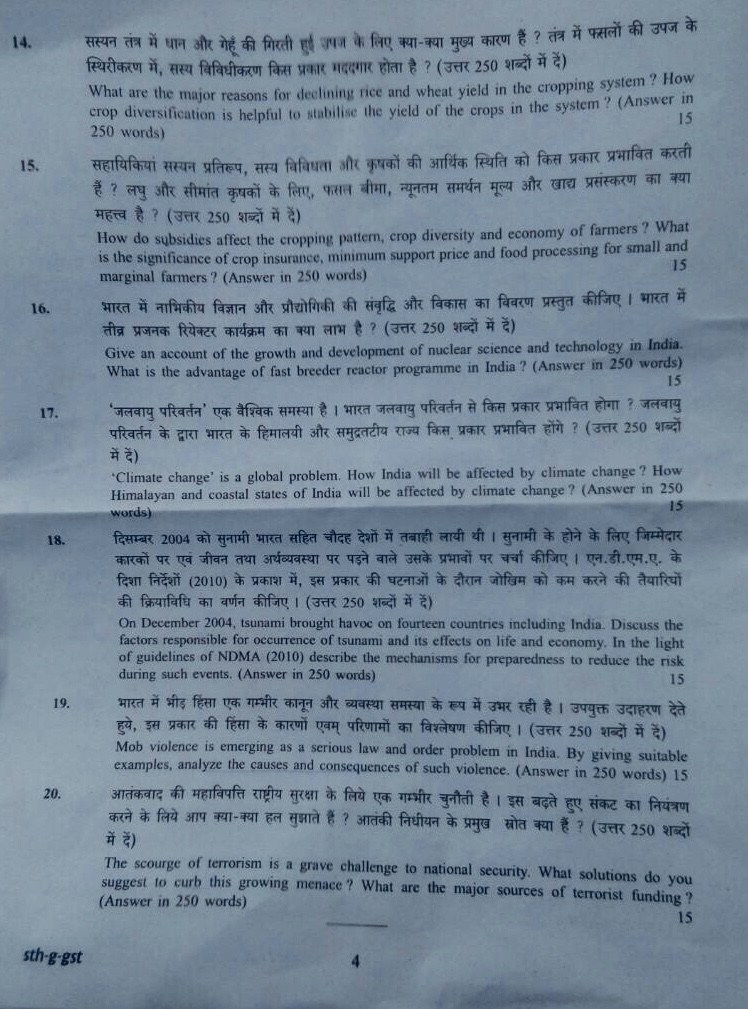
  14. What are the major reasons for declining rice and wheat yield in the cropping system? How crop diversification is helpful in stabilize the yield of the crops in the system? (Answer in 250 words) 15 Marks
  15. How do subsidies affect the cropping pattern, crop diversity and economy of farmers? What is the significance of crop insurance, minimum support price and food processing for small and marginal farmers? (Answer in 250 words) 15 Marks
  16. Give an account of the growth and development of nuclear science and technology in India. What is the advantage of fast breeder reactor programme in India? (Answer in 250 words) 15 Marks
  17. Climate change' is a global problem. How India will be affected by climate change? How Himalayan and coastal states of India will be affected by climate change? (Answer in 250 words) 15 Marks
  18. On December 2004, tsunami brought havoc on fourteen countries including India. Discuss the factors responsible for occurrence of tsunami and its effects on life and economy. In the light of guidelines of NDMA (2010) describe the mechanism for preparedness to reduce the risk during such events. (Answer in 250 words) 15 Marks
  19. Mob violence is emerging as a serious law and order problem in India. By giving suitable examples, analyze the cause and consequences of such violence? (Answer in 250 words) 15 Marks
  20. The scourge of terrorism is a grave challenge to national security. What solutions do you suggest to curb this growing menace? What are the major sources of terrorist funding? (Answer in 250 words) 15


UPSC MAINS 2017 - G.S PAPER IV


  1.  Conflict of interest in the public sector arises when

    (a) official duties

    (b) public interest, and

    (c) personal interest

    are taking priority one above the other.

    How can this conflict in administration be resolved? Describe with an example. (150 Words) (10)
  2.  Examine the relevance of the following in the context of civil service: (150 Words) (10)

    (a) Transparency

    (b) Accountability

    (c) Fairness and justice

    (d) Courage of conviction

    (e) Spirit of service
  3. Young people with ethical conduct are not willing to come forward to join active politics. Suggest steps to motivate them to come forward. (150 Words) (10 Marks )
  4. (a) One of the tests of integrity is complete refusal to be compromised. Explain with reference to a real life example. (150 Words) (10)

    (b) Corporate social responsibility makes companies more profitable and sustainable. Analyse. (150 Words) (10)
  5. (a) “Great ambition is the passion of a great character. Those endowed with it may perform very good or very bad acts. All depends on the principles which direct them.” – Napoleon Bonaparte. Stating examples mention the rulers

     (i) who have harmed society and country,

    (ii) who worked for the development of society and country. (150 Words) (10)


    (b) “If a country is to be corruption free and become a nation of beautiful minds, I strongly feel there are three key societal members who can make a difference. they are father, the mother and the teacher.” – A. P. J. Abdul Kalam. Analyse. (150 Words) (10)
  6. (a) How will you apply emotional intelligence in administrative practices? (150 Words) (10)

    (b) Strength, peace and security are considered to be the pillars of international relations. Elucidate. (150 Words) (10)
  7. (a) The crisis of ethical values in modern times is traced to a narrow perception of the good life. Discuss. (150 Words) (10)

    (b) Increased national wealth did not result in equitable distribution of its benefits. It has created only some “enclaves of modernity and prosperity for a small minority at the cost of the majority.” Justify. (150 Words) (10)
  8. (a) Discipline generally implies following the order and subordination. However, it may be counter-productive for the organisation. Discuss. (150 Words) (10)

    Without commonly shared and widely entrenched moral values and obligations, neither the law, nor democratic government, nor even the market economy will function properly.

    (b) What do you understand by this statement? Explain with illustration in the contemporary times. (150 Words) (10)

    Section- B
  9. You are an honest and responsible civil servant. You often observe the following:

    (a) There is a general perception that adhering to ethical conduct one may face difficulties to oneself and cause problems for the family, whereas unfair practices may help to reach the career goals.

    (b) When the number of people adopting unfair means is large, a small minority having a penchant towards ethical means makes no difference.

    (c) Sticking to ethical means is detrimental to the larger developmental goals

    (d) While one may not involve oneself in large unethical practices, but giving and accepting small gifts makes the system more efficient. Examine the above statements with their merits and demerits. (250 Words, 20)


    Examine the above statements with their merits and demerits. (250 Words)
  10. You are aspiring to become an IAS officer and you have cleared various stages and now you have been selected for the personal interview. On the day of the interview, on the way to the venue you saw an accident where a mother and child who happen to be your relatives were badly injured. They needed immediate help.

    What would you have done in such a situation? Justify your action. (250 Words) (20)
  11. You are the head of the Human Resources department of an organisation. One day one of the workers died on duty. His family was demanding compensation. However, the company denied compensation because it was revealed in investigation that he was drunk at the time of the accident. The workers of the company went to strike demanding compensation for the family of the deceased. The Chairman of the management board has asked for your recommendation.

    What recommendation would you provide the management? Discuss the merits and demerits of each of the recommendations. (250 Words) (20)
  12. You are the manager of a spare parts company A and you have to negotiate a deal with the manager of a large manufacturing company B. The deal is highly competitive and sealing the deal is critical for your company. The deal is being worked out over a dinner. After dinner the manager of manufacturing company B offered to drop you to the hotel in his car. On the way to hotel he happens to hit motorcycle injuring the motorcyclist badly. You know the manager was driving fast and thus lost control. The law enforcement officer comes to investigate the issue and you are the sole eyewitness to it. Knowing the strict laws pertaining to road accidents you are aware that your honest account of the incident would lead to the prosecution of the manager and as a consequence the deal is likely to be jeopardized, which is of immense importance to your company. What are the dilemmas you face? What will be your response to the situation? (250 Words) (20)
  13. A building permitted for three floors, while being extended illegally to 6 floors by a builder, collapses. As a consequence, a number of innocent laborers including women and children died. These labourers are migrants of different places. The government immediately announced cash relief to the aggrieved families and arrested the builder.

    Give reasons for such incidents taking place across the country. Suggest measures to prevent their occurrence. (250 Words) (20)
  14. You are a Public Information Officer (PIO) in a government department. You are aware that the RTI Act 2005 envisages transparency and accountability in administration. The act has functioned as a check on the supposedly arbitrarily administrative behavior and actions. However, as a PIO you have observed that there are citizens who filed RTI applications not for themselves but on behalf of such stakeholders who purportedly want to have access to information to further their own interests. At the same time there are these RTI activists who routinely file RTI applications and attempt to extort money from the decision makers. This type of RTI activism has affected the functioning of the administration adversely and also possibly jeopardises the genuineness of the applications which are essentially aimed at getting justice.

    What measures would you suggest to separate genuine and non-genuine applications? Give merits and demerits of your suggestions.


Monday, 30 October 2017

Essay Paper of SPIPA

Exam was held on 16/09/2018 for Essay writing which was conducted by SPIPA as part of selection

of student for batch 2018-2019  coaching for UPSC Civil services (IAS, IPS, IFS etc ).

The paper contain two section with both the section are compulsory and carry 50 marks each .


Exam was held on 29/10/2017 for Essay writing which was conducted by SPIPA as part of selection

of student for batch 2017-20118  coaching for UPSC Civil services (IAS, IPS, IFS etc ).

The paper contain two section with both the section are compulsory and carry 50 marks each .


Download also