Showing posts with label Conventions. Show all posts

Tuesday, 22 May 2018

TALANOA DIALOGUE

WHAT IS TALANOA?
Talanoa is a traditional word used in Fiji and the Pacific to reflect a process of inclusive, participatory and transparent dialogue. The purpose of Talanoa is to share stories and build empathy in order to make wise decisions that are for the collective good. The process of Talanoa involves the sharing of ideas, skills and experience through storytelling.
During the process of the Talanoa Dialogue, Parties will build trust and advance knowledge through empathy and understanding. Blaming others and making critical observations is inconsistent with the building of mutual trust and respect, and therefore inconsistent with the methodology of the Talanoa Dialogue. The spirit of talanoa acknowledges that no-one, no matter how powerful, can solve the climate challenge on their own.
WHAT IS THE EXPECTED OUTCOME OF THE TALANOA DIALOGUE?
The Talanoa Dialogue is designed to take stock of collective efforts to reduce emissions in line with the long-term goals of the Paris Agreement and to inform the preparation of Nationally Determined Contributions (NDCs). Ultimately, the goal is to help countries increase the ambition of their NDCs by 2020. However, the specific outcome will be determined by Parties during the political phase at COP24.
WHAT ARE THE EXPECTATIONS OF PARTIES BOTH IN TERMS OF THE CONTENT AND TIMING OF SUBMISSIONS?
The Presidencies have released guidance for submissions from Parties, similar to that issued for non-Party stakeholders (NPS). Although not mandatory, we hope that it will help Parties shape their submissions. The process is designed to allow Parties and NPS take stock of where they currently are in the climate journeys (i.e. actions and commitments) and where they need to go.
This is a useful opportunity to reflect on the progress and achievements that have been made so far, as well as on the reforms, incentives, technologies, business models and new forms of collaboration that still need to be developed, undertaken or adopted.
We are requesting that submissions be clear, concise and constructive to allow important information and innovation to be shared, and to foster knowledge transfer and best practices among stakeholders. This will also help us ensure accurate translation when summarising all submissions for the final synthesis report.
We encourage Parties to take the time they need to prepare their inputs, but the sooner Parties can submit them, the more time the inputs will have help shape the ongoing dialogue.
IS THE TALANOA DIALOGUE FOCUSED SOLELY ON MITIGATION, OR CAN INPUTS INCLUDE ADAPTATION AND RESILIENCE CONSIDERATIONS?
The Talanoa Dialogue is ultimately designed to help the world achieve the long-term goals of the Paris Agreement by encouraging Parties to submit more ambitious NDCs. Adaptation and resilience are important components in the NDCs of developing of countries and are critical for achieving the overarching goals of the Paris Agreement, including promoting sustainable development. Even if all countries were to immediately enact the most ambitious mitigation efforts possible, the current levels of greenhouse gases in the atmosphere would still cause the impacts of climate change to worsen for some time, putting the lives and livelihoods of vulnerable communities under threat.
So whilst the 1.5/2 degrees target is critically important, strengthening the capacity of vulnerable societies to adapt to the adverse impacts of climate change is necessary to ensure a sustainable transition towards a net-zero emission society as early as possible. This makes the discussion on adaptation and resilience relevant to the Talanoa Dialogue. We encourage you in particular to share experiences and lessons on actions and initiatives that address both adaption and mitigation.
WHAT ABOUT ISSUES LIKE HEALTH AND GENDER?
Consideration of “cross-cutting” issues like health and gender can also be included in submissions where it is relevant to the climate action or initiative that is being discussed in the context of the three core questions.
CAN INDIVIDUALS CONTRIBUTE TO THE TALANOA DIALOGUE?
Yes, individuals can contribute to the Talanoa Dialogue. However, individuals thinking about submitting an input are encouraged to consider how they can join efforts with others to prepare a joint input. This will help the Presidencies and secretariat in their work to consolidate the submissions.
CAN PARTIES INVITE NPS TO SUBMIT INPUTS?
Yes, however the submission should clearly indicate the entity(-ies) making the submission. We want to hear as many and as diverse a range of stories as possible. In order to address the great climate change challenge, we need to reach a new level of global collaboration between governments, cities, businesses, investors, civil society, the scientific community and ordinary men and women. No one actor can solve this problem alone and so Parties are encouraged to collaborate with NPS in their submissions or to encourage them to submit their own inputs.
We encourage all stakeholders to consider ways to consolidate inputs or prepare joint inputs where appropriate, in order to aid in the production of the synthesis report.
DO INPUTS NEED TO INCLUDE CONCRETE PROJECTS, INNOVATIONS OR GOALS?
It would be helpful to include these but it is not mandatory. However, remember that the Dialogue is designed to promote the sharing of stories, ideas and information that the world can learn from, both in terms of what has worked and what hasn’t worked in terms of mitigation and adaptation initiatives and related enabling mechanisms like policy, governance, regulation, financing and institutional structures. Information should be relevant for enhancing the next round of NDCs and concrete examples, lessons and experiences will help achieve this.
WHAT IF I MISS 2 APRIL DEADLINE?
Any input received later to that deadline will still appear on the Talanoa Dialogue Online Platform and will be included in the final synthesis report, but will not be part of the materials that the secretariat will produce in time for the May sessions.
HOW WILL THE OUTCOMES OF MAY SESSIONS IMPACT THE POLITICAL PHASE?
The outcomes of the May Sessions will be summarised in a report that will also include the summary of the portal submissions received up to 2 April 2018 as well as the outputs of the technical expert meetings (TEMs). This summary report will provide early signals on the elements to need to be discussed in the political phase at COP24. The summary report, along with other submissions and inputs during the rest of the year, will be fed into the final synthesis report that will be discussed at the political phase.
WHAT ARE THE OPPORTUNITIES TO ENGAGE BETWEEN MAY AND COP24?
The preparatory phase is expected to run throughout the year and until COP24. Additional information on the conduct of the preparatory phase will be provided after the May sessions. The Presidencies further encourage Parties and non-Party stakeholders to continue to cooperate in convening local, national, regional or global events in support of the Talanoa Dialogue.
A second deadline for inputs has been set for 29 October 2018. Any input received later to that deadline will still appear on the Online Platform, but will not be part of the materials that the secretariat produce in time for COP24.
HOW WILL THE PRESIDENCIES PREPARE THE SYNTHESIS REPORT?
We must ensure that the report accurately reflects the submissions and serves as a useful tool for political leaders a view of where we are in terms of current mitigation and adaptation efforts; goals and visions; and clear directions on how to get there.
The Presidencies will assess how best to accomplish this as submissions are reviewed. At this stage, it is already clear that the synthesis report will need to be succinct, credible, easy to access and organised in a clear and logical fashion. It will be informed by science and present clear directions and messages for how to enhance and implement NDCs.
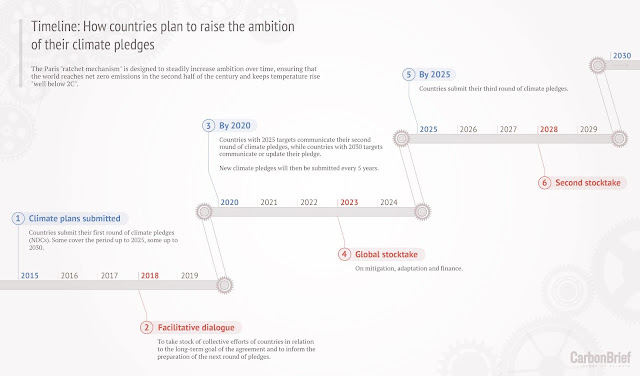
Ratchet Mechanism

The Paris Ratchat Mechanism is designed to steady increase ambition over the time , Ensuring that world reaches net zero emission in the second half of the century and keeps temperature 'well below 2 C '.


Stage one: NDCs 1.0
Even though the agreement has not yet come into force, this cyclical process is already underway.
In the nine months before Paris, countries submitted their “intended nationally determined contributions”, which are regularly abbreviated to INDCs.
Each of these contains the country’s intended domestic target for reducing or slowing its greenhouse gas emissions. Others contained information on topics, such as adaptation, loss and damage and financial need, according to individual preference.
The 160 submissions received by the UN remain “intended”, and are not set in stone until the country in question ratifies the agreement. Indeed, many countries stressed that their contribution was contingent upon the outcome of the UN deal struck in Paris.
Countries are not legally bound to meet the targets in their nationally determined contribution (NDC), but they must take action “with the aim of achieving” their goals.
However, the current policies do not collectively achieve the agreement’s aim to keep temperature rise to below 2C — and are even further from its aspirational target of limiting it to 1.5C.
Stage two: Facilitative dialogue
The ratcheting up of ambition really begins in 2018, when countries have agreed to convene a “facilitative dialogue”.
This is a chance for countries to take stock of how close they are to achieving the long-term goals of the agreement to peak emissions as soon as possible and achieve net zero emissions in the second half of the century.
This dialogue is designed to inform the next round of NDCs, so that countries have a clearer idea of the direction of travel.
Stage three: NDCs 2.0
With the outcome of the facilitative dialogue in mind, countries have to either update or communicate a new NDC by 2020.
Due to the flimsy set of rules guiding the first round of NDCs, the submissions cover various timeframes. Some set a target for 2030, such as the EU. Others have a target for 2025, such as the US.
For countries with a target covering the period up to 2025, they must communicate a new NDC by 2020. For those with 2030 targets, they must “communicate or update” these by 2020.
The agreement says that the efforts of each country will “represent a progression over time”, and reflect its “highest possible ambition”. For developed countries, these should be economy-wide, absolute emission targets, while developing countries are encouraged to move towards this kind of target over time. The division between developed and developing countries is now more fluid than it was before the agreement.
This does not mean that the ambition contained within each country’s current NDC is frozen in place. The agreement says that a country can adjust its contribution “at any time…with a view to enhancing its level of ambition” — but there is no strict obligation to undertake such improvements.
Once the agreement has come into force, countries will agree a common timeframe for their future contributions. This means that future cycles will eventually fall into line, with every country setting targets covering the same time period.
Countries must thereafter continue to submit new NDCs every five years. Alongside these, they are also encouraged to submit an “adaptation communication”, which includes its priorities, plans and needs. Every two years, developed countries also have to communicate how much climate finance they will provide to developing countries.
Stage four: Global stocktake
In 2023, just before the third round of NDCs are due to be submitted, the UN has agreed there will be a “global stocktake”.

Thursday, 9 November 2017

Warsaw convention

  This refers to an international agreement that defines the rules and regulations that govern civil aviation. It was initially signed by a small group of countries but has since been amended multiple times and now been adopted by most countries in the world. 

Among other things, the Warsaw Convention defines the potential liability that an international carrier faces with regards to the air transport of people and luggage of various kinds. It helps provide a common framework for dispute resolution between parties belonging to different countries.

Wednesday, 13 September 2017

11th Sept Daily current affairs for UPSC Civil Service Exam

Xafecopy Trojan
  • It is a new malware detected in India which steals money through victims' mobile phones.
  • Its attacks are targeted in countries where mobile payment method is popular.
  • Around 40% of target of the malware has been detected in India.
  • It uses technology to bypass 'captcha' systems designed to protect users by confirming the action is being performed by a human.
  • This malware can delete incoming text messages to hide alerts from mobile network operators about stolen money.
Giant African snail
  • The infestation of giant African snail in the key coffee-growing areas of Karnataka has triggered concerns.
  • The pest has surfaced over an estimated 1,500 acres this year.
  • It has led to higher cultivation costs, impacting earnings of coffee and pepper.
  • The tender plants of coffee, pepper vines and papaya, among others, have been damaged by the pests in the regions.
  • This snail species has been considered a significant cause in pest issues around the world.
  • Internationally, it is the most frequently occurring invasive species of snail.
  • It is a nuisance pest for urban areas, and spreads human disease.
Latest edition of consolidated policy
  • The Department of Industrial Policy & Promotion (DIPP) has released its latest edition of consolidated Foreign Direct Investment Policy.
  • The consolidated policy lays down the general conditions on FDI, procedures for government approval and sector specific conditions on FDI.
FDI policy for Start-ups
  • The policy specifies that start-ups can raise up to 100% of funds from Foreign Venture Capital Investor (FVCI) against receipt of foreign remittance.
  • A start-up company engaged in a sector where foreign investment requires government approval may issue convertible notes to a non-resident only with the approval of the government.
FDI policy for Airlines
  • According to the new policy, the Centre will not allow foreign airlines to pick a stake in Air India.
  • Foreign airlines are allowed to invest in the capital of Indian companies operating scheduled and non-scheduled air transport services up to the limit of 49%.
  • In effect, this rules out the participation of any foreign airline in the proposed Air India divestment.
Folic acid
  • Folic acid significantly lowers the risk of developing autism spectrum disorder (ASD) in children, even when their mothers are exposed to household or agricultural pesticides associated with increased risk.
  • Folic acid is essential for the body to make DNA, RNA, and metabolise amino acids which are required for cell division.
  • It may be taken orally or by injection.
Autism Spectrum Disorder
  • Autism spectrum disorder (ASD) is the name for a group of developmental disorders.
  • ASD includes a wide range, “a spectrum” of symptoms, skills, and levels of disability.
  • People with ASD often have these characteristics:
  1. Ongoing social problems that include difficulty in communicating and interacting with others.
  2. Repetitive behaviours as well as limited interests or activities.
  3. Symptoms that typically are recognized in the first two years of life.
  4. Symptoms that hurt the individual’s ability to function socially, at school or work, or in other areas of life.
ICEX
  • The Indian Commodity Exchange (ICEX) launched the world's first diamond futures contracts to provide exporters with a hedging tool.
  • Diamond was notified as a commodity for derivatives trading on online exchanges.
  • Indian Commodity Exchange Limited is a screen based on-line derivatives exchange for commodities and has established a reliable, time tested, and a transparent trading platform.
  • It has set up process by putting in place grading and vaulting facilities in order to facilitate deliveries.
  • Major shareholders are Reliance Exchangenext Ltd, Indiabulls Financial Services Ltd., Indian Potash and IDFC Bank.

Source: Sankar IAS

Sunday, 10 September 2017

10th Sept Daily current affairs for UPSC Civil Service Exam

Anti-Tank Missile
  • India’s indigenously developed 3rd generation Anti Tank Guided Missile (ATGM), NAG has been successfully flight tested twice by DRDO.
  • NAG, also known as Prospina, is a guided missile primarily designed to hit and destroy heavily armored military vehicles.
  • India is looking to purchase 4th generation Anti Tank missile named Spike Missile from Israel.
Lakshadweep Island
  • Parali I island, uninhabited and part of Bangaram atoll in Lakshadweep, has vanished due to erosion.
  • All the five islets of Bangaram atoll such as Bangaram, Thinnakara, Parali I, II and III, had undergone erosion and Parali I has been inundated.
  • Lakshadweep, formerly known as the Laccadive, Minicoy, and Aminidivi Islands is a group of islands in the Laccadive Sea, off the south western coast of India.
  • Kavaratti serves as the capital of the Union Territory and the region comes under the jurisdiction of Kerala High Court.
  • Nine degree channel separates Laccadive and Minicoy islands.
  • The islands form the smallest Union Territory of India.

    Swachhathon 1.0
    • Swachhathon 1.0, the first ever Swachh Bharat Hackathon, was organized by the Ministry of Drinking Water and Sanitation.
    • It is organised to crowd source solutions to some of the Sanitation and Hygiene challenges faced in various parts of the country.
    • It invited innovators from schools and colleges, institutions, start-ups and others to come up with solutions for problems like monitoring usage of toilets, triggering behaviour change, Solution for early decomposition of faecal matter, toilet technologies in difficult terrains etc.
    Sakshar Bharat Awards
    • On the occasion of 51st International Literacy day, Ministry of Human Resource Development conferred Sakshar Bharat Awards.
    • The award was constituted to encourage contribution in promoting literacy at grass root levels.
    • It also recognizes the achievements and invaluable contributions of functionaries and volunteers in the field of adult education and skill development.
    • Under the category of State Literacy Mission Authority, Chhattisgarh State has won the award.
    FAME India Scheme
    • FAME India Scheme [Faster Adoption and Manufacturing of (Hybrid &) Electric Vehicles in India] was launched by Ministry of Heavy Industries and Public Enterprises.
    • The objective is to support hybrid/electric vehicles market development and Manufacturing eco-system.
    • It is aimed at incentivizing all vehicle segments i.e. 2 Wheeler, 3 Wheeler Auto, Passenger 4 Wheeler Vehicle, Light Commercial Vehicles and Buses.
    • The scheme's phase-I was introduced from April 1, 2015, to March 31, 2017.
    • The phase was subsequently extended by six months till September end.
    • The scheme has 4 focus areas i.e. Technology development, Demand Creation, Pilot Projects and Charging Infrastructure.

    Source: PIB, The Hindu and Economic Times

What are El Niño and La Niña events?

El Niño and La Niña events are a natural part of the global climate system. They occur when the Pacific Ocean and the atmosphere above it change from their neutral ('normal') state for several seasons. El Niño events are associated with a warming of the central and eastern tropical Pacific, while La Niña events are the reverse, with a sustained cooling of these same areas.

These changes in the Pacific Ocean and its overlying atmosphere occur in a cycle known as the El Niño–Southern Oscillation (ENSO). The atmosphere and ocean interact, reinforcing each other and creating a 'feedback loop' which amplifies small changes in the state of the ocean into an ENSO event. When it is clear that the ocean and atmosphere are fully coupled an ENSO event is considered established.

Even in a neutral state, temperatures in the Pacific Ocean vary from east to west – for example, the western Pacific 'warm pool' in the tropical Pacific has some of the warmest large-scale ocean temperatures in the world. During an ENSO event, ocean temperatures become warmer than usual or cooler than usual at different locations, which are reflected in ocean temperature gradients. The most important driver of ENSO is these temperature gradients across the Pacific, both at the surface and below the surface, particularly at the thermocline.


Pacific Ocean – even in neutral state the Western Pacific is warm

Why are they called El Niño and La Niña?

The term El Niño translates from Spanish as 'the boy-child'. Peruvian fishermen originally used the term to describe the appearance, around Christmas, of a warm ocean current off the South American coast. It is now the commonly accepted term to describe the warming of the central and eastern tropical Pacific Ocean. La Niña translates as 'girl-child' and is the opposite ENSO phase to El Niño.

Coupled

Because ENSO involves interaction between the ocean and the atmosphere – both of which play a role in reinforcing changes in each other – it is known as a coupled ocean–atmosphere phenomenon.


ENSO impacts 

rainfall

The complex interactions between the ocean, atmosphere and adjacent landmasses across the Pacific mean that ENSO events have impacts on weather in areas outside the tropical Pacific region. El Niño and La Niña events are associated with distinct climatic conditions around the Pacific.
La Niña events are associated with greater convection over the warmer ocean to Australia's north. Typically this leads to higher than average rainfall across much of Australia, particularly inland eastern and northern regions, sometimes causing floods.
During El Niño events, the ocean near Australia is cooler than usual, bringing lower than average winter–spring rainfall over eastern and northern Australia. Although most major Australian droughts have been associated with El Niño events, widespread drought is certainly not guaranteed when an El Niño is present.

Rainfall patterns during La Niña and El Niño events


Australian rainfall data for 13 of the strongest 'classic' or 'canonical' events (having the typical autumn to autumn pattern of evolution and decay) since 1900 have been combined to form a composite of average impacts of La Niña and El Niño events upon rainfall across Australia.
Each map shows mean rainfall deciles, where green to blue tones indicate above-average to very much above-average rainfall totals and yellow to red tones indicate below-average to very much below-average rainfall. Note that the rainfall patterns can vary significantly from one event to the next.


El Niño

El Niño is typically associated with reduced rainfall northern and eastern Ausintralia.

La Niña

La Niña is typically associated with increased rainfall in northern and eastern Australia.


Thermocline

Thermocline comes from the Greek for 'heat slope' and is the name for the region separating warm, well-mixed surface water from cool, deep ocean water. Typically water temperatures above the thermocline are more than 25°C while those below the thermocline are 15°C or less.


The El Niño–Southern Oscillation (ENSO) is described in more detail in the section The three phases of ENSO.

Friday, 8 September 2017

7th Sept Daily current affairs for UPSC Civil Service Exam

Task Force on Employment, Exports
  • NITI Aayog has set up a task force on employment and export, headed by its Vice-Chairman Rajiv Kumar.
  • It will propose a plan of action to generate employment and alleviate under-employment and low wages by boosting India’s exports in key labour-intensive industries.
  • It focuses on both goods and service sectors.
UJALA Scheme in Malaysia
  • Government of India has launched Ministry of Power flagship scheme UJALA (Unnat Jyoti by Affordable Lighting for All) in the State of Melaka, Malaysia.
  • The successful Indian model of UJALA scheme has become a sought-after example for the different nations of the world.
  • Under this, Energy Efficiency Services Limited (EESL) plans to distribute about 1 million LED bulbs, which will replace CFLs.
  • The initiative will have the logistical assistance and facilitation support from Green Growth Asia, which is a not for profit organization.
  • The price of each bulb will be way lesser than global average price of the LED bulb.
Ananda Temple
  • It is a Buddhist temple in Myanmar, built in the early 12th century.
  • It is based on Indian Style of Architecture.
  • Archaeological Survey of India (ASI) has carried out structural conservation and chemical preservation work of this temple.
  • The ASI has undertaken several major conservation works across various countries of Asia such as Bamiyan Buddhas in Afghanistan, the Angkor Wat in Cambodia, the Ta Prohm Temple in Cambodia, the Vat Phou Temple in Laos, and the My Son Temple in Vietnam.

Zika virus

  • Scientists have found that Zika virus can kill deadly brain cancer cells that are resistant to standard treatments.
  • The virus is known for causing babies to be born with tiny deformed heads called as Microcephaly.
  • The researchers found that the lethal power of the virus in infecting and killing cells could be directed at malignant cells in the brain.
  • It may pave way for an effective treatment for glioblastoma, a deadly form of brain cancer.
  • The virus specifically targets and kills neuroprogenitor cells which are rare in the adult brain. Thus it may be safer for use in adults.
World University Rankings 2018
  • The Times Higher Education “World University Rankings 2018” list the top 1,000 universities in the world.
  • It is the only global university performance table to judge research-intensive universities across all of their core missions: teaching, research, knowledge transfer and international outlook.
  • The ranking is topped by University of Oxford, UK followed by University of Cambridge, UK.
  • 42 Indian institutions figure in this year’s list. But the highest ranked, the Indian Institute of Science, Bengaluru, weighs in only in the 251-300 range.
  • Overall, European institutions occupy half of the top 200 places, with the Netherlands, Germany and UK as the most-represented countries.
  • Asia’s top university, the National University of Singapore, has ranked in 22nd place.

    First Hyperloop Transport System
    • Hyperloop Transportation Technologies (HTT) has signed an agreement with the Andhra Pradesh government to set up first Hyperloop transport system in India.
    • The system will connect the city centres of Amravati and Vijayawada.
    • The technology uses a high-speed train that promises travel at twice the speed of a commercial aircraft.
    • Hyperloop consists of a low pressure tube with capsules that are transported at both low and high speeds throughout the length of the tube.
    • The project will be implemented in PPP mode.

    Source: PIB, Business Line, Financial Express

6th Sept Daily current affairs for UPSC Civil Service Exam

National Nutrition Strategy
  • To address the slow pace of decline in the under nutrition and to bring nutrition to the centre-stage ofthe National Development Agenda, NITI Aayog has drafted the National Nutrition Strategy.
  • The Strategy lays down a roadmap for effective action, among both implementers and practitioners, in achieving our nutrition objectives.
  • It envisages a framework wherein the following four determinants of nutrition work together to accelerate decline of under nutrition in India –
    1. Uptake of health services,
    2. Food,
    3. Drinking water & sanitation and
    4. Income & livelihoods.
  • Currently, there is a lack of real time measurement of these determinants, which reduces our capacity for targeted action.
  • The framework envisages a Kuposhan Mukt Bharat - linked to Swachh Bharat and Swasth Bharat.
  • It enables states to make strategic choices, through decentralized planning and local innovation, with accountability for nutrition outcomes.
Surya Kiran
  • India and Nepal began their 12th edition of joint military exercise with around 300 troops each side in Rupandehi district in the western part of Nepal.
  • It focuses on counter-terrorism and forest fighting operations.
  • According to the Indian Army officials, the Surya Kiran is the largest joint exercise in terms of troop participation.
  • Disaster management and joint operations for disaster relief will also be a part of the exercise.
  • The exercise will provide the two armies a platform to exchange experiences, ideas and skills.
  • Surya Kiran series of exercises are held alternately in India and Nepal.
Domestic Systemically Important Banks (D-SIBs)
  • Following the global financial crisis of 2008, it was observed that problems faced by certain large and highly interconnected financial institutions hampered the functioning of the financial system.
  • This in turn negatively impacted the real economy.
  • It was decided to identify such institutions and prescribe them higher capital requirements.
  • Following this, RBI had started listing D-SIBs from August 2015.
  • The banking regulator prescribes higher capital requirements for such entities.
  • HDFC Bank is the second largest private sector lender of the country
  • RBI has added HDFC in the list of D-SIBs.
  • State Bank of India and ICICI Bank are also in this category.
Central Vigilance Commissioner (CVC)
  • CVC is the chief of the country’s top anti-corruption body- Central Vigilance Commission.
  • Central Vigilance Commission (CVC) is an autonomous apex Indian governmental body created to address governmental corruption.
  • It is free of control from any executive authority, charged with monitoring all vigilance activity under the Central Government of India.
  • The Commission shall consist of
    1. A Central Vigilance Commissioner - Chairperson;
    2. Not more than two Vigilance Commissioners - Members;
  • Recently allegations were raised in a PIL, challenging the appointments as “arbitrary, illegal and in violation of the principle of institutional integrity.”
  • The Centre told the Supreme Court that K.V. Chowdary was appointed Central Vigilance Commissioner (CVC), with the “unanimous consensus” of a high-profile committee led by the Prime Minister in June 2015.
Advance Pricing Agreement
  • The Central Board of Direct Taxes (CBDT) has entered into Advance Pricing Agreements (APAs) between Indian Company and UK based Company.
  • An APA is a contract, usually for multiple years, between a taxpayer and at least one tax authority specifying the pricing method that the taxpayer will apply to its related-company transactions.
  • It was introduced in IT act, 2012.
  • It helps taxpayers voluntarily resolve transfer pricing disputes in a cooperative manner reducing the incidence of double taxation.
  • It also involves resolving both the future and existing transfer pricing audits and adjustments.
  • It fosters a non-adversarial tax regime.
  • Unilateral APA – It involve agreements between only the taxpayer and one government.
  • Bilateral APA – Tax payer enter into APA with more than one tax authority.
  • Transfer Pricing - A transfer price is the price at which different divisions of a same company transact good or services with each other.
  • Transfer pricing are used when individual entities of a large multi-entity firm are treated as separately run entities.

Source: The Hindu, Indian Express, PIB