Showing posts with label Commitittees. Show all posts

Tuesday, 22 May 2018

Ratchet Mechanism

The Paris Ratchat Mechanism is designed to steady increase ambition over the time , Ensuring that world reaches net zero emission in the second half of the century and keeps temperature 'well below 2 C '.
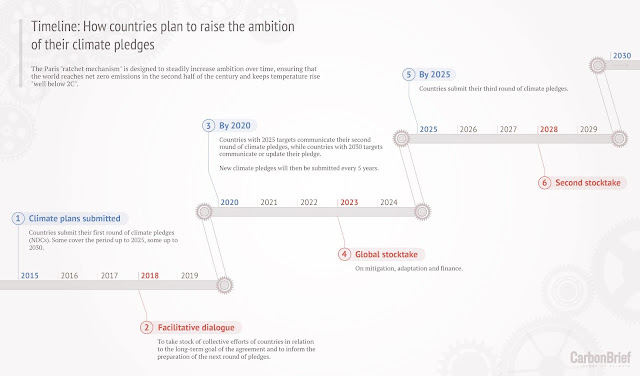


Stage one: NDCs 1.0
Even though the agreement has not yet come into force, this cyclical process is already underway.
In the nine months before Paris, countries submitted their “intended nationally determined contributions”, which are regularly abbreviated to INDCs.
Each of these contains the country’s intended domestic target for reducing or slowing its greenhouse gas emissions. Others contained information on topics, such as adaptation, loss and damage and financial need, according to individual preference.
The 160 submissions received by the UN remain “intended”, and are not set in stone until the country in question ratifies the agreement. Indeed, many countries stressed that their contribution was contingent upon the outcome of the UN deal struck in Paris.
Countries are not legally bound to meet the targets in their nationally determined contribution (NDC), but they must take action “with the aim of achieving” their goals.
However, the current policies do not collectively achieve the agreement’s aim to keep temperature rise to below 2C — and are even further from its aspirational target of limiting it to 1.5C.
Stage two: Facilitative dialogue
The ratcheting up of ambition really begins in 2018, when countries have agreed to convene a “facilitative dialogue”.
This is a chance for countries to take stock of how close they are to achieving the long-term goals of the agreement to peak emissions as soon as possible and achieve net zero emissions in the second half of the century.
This dialogue is designed to inform the next round of NDCs, so that countries have a clearer idea of the direction of travel.
Stage three: NDCs 2.0
With the outcome of the facilitative dialogue in mind, countries have to either update or communicate a new NDC by 2020.
Due to the flimsy set of rules guiding the first round of NDCs, the submissions cover various timeframes. Some set a target for 2030, such as the EU. Others have a target for 2025, such as the US.
For countries with a target covering the period up to 2025, they must communicate a new NDC by 2020. For those with 2030 targets, they must “communicate or update” these by 2020.
The agreement says that the efforts of each country will “represent a progression over time”, and reflect its “highest possible ambition”. For developed countries, these should be economy-wide, absolute emission targets, while developing countries are encouraged to move towards this kind of target over time. The division between developed and developing countries is now more fluid than it was before the agreement.
This does not mean that the ambition contained within each country’s current NDC is frozen in place. The agreement says that a country can adjust its contribution “at any time…with a view to enhancing its level of ambition” — but there is no strict obligation to undertake such improvements.
Once the agreement has come into force, countries will agree a common timeframe for their future contributions. This means that future cycles will eventually fall into line, with every country setting targets covering the same time period.
Countries must thereafter continue to submit new NDCs every five years. Alongside these, they are also encouraged to submit an “adaptation communication”, which includes its priorities, plans and needs. Every two years, developed countries also have to communicate how much climate finance they will provide to developing countries.
Stage four: Global stocktake
In 2023, just before the third round of NDCs are due to be submitted, the UN has agreed there will be a “global stocktake”.

Saturday, 12 May 2018

Sargeant plan of Education 1944

The Sergeant Plan was worked out by the Central advisory board of education in 1944 

Recommendation of Sargeant plan of Education 1944               
  1. Pre primary education for the 3-6 age group , free , universal and compulsory elementary education for 6-11 year age , high school education for 11-17 year age group for selected children , and a university course of 3 year after the higher secondary high schools to be of two types 
1) Academic 
2) Technical and Vocational 

  1. adequate technical , commercial and Arts education.
  2. abolition of intermediate course .
  3. Liquidation of adult illiteracy in 20 year.
  4. stress on teacher training , physical education , education for the physically and mentally handicapped .

the objective was to create within 40 Years the same levels of educational attainment as prevailed in England. although a bold and comprehensive scheme , it proposed no methodology for implementation . Also the ideal of England's achievement may not have suited  Indian conditions.

Hartog Committee ,1929

An increase in number of schools and college had led to deterioration of education standards. The Hartog Committee was set up to report on development of education .

Main Recommendation                                                                     
  1. Emphasis should be on primary education but there need be no hasty expansion or compulsion in education.
  2. Only deserving students should go in for high school and intermediate stage , while average students should be diverted to vocational course after VIII standards.
  3. For Improvements in standards of University education , admission should be Restricted.


........................................................................................................................................................................................................


Thursday, 18 January 2018

Govt. to revisit Malimath report


                  A 2003 report of a Committee on reforms in the criminal justice system that recommended admissibility of confessions made before a police oofficer as evidence in a court of law is being revisited by the Centre, a senior government offcial said. The Committee on Reforms of the Criminal Justice System, or the Justice Malimath Committee, was  constituted by the Home Ministry in 2000 by then Deputy Prime Minister L.K. Advani, who also held the Home portfolio. It was headed by Justice V.S. Malimath, former Chief Justice of the Karnataka and Kerala High Courts.  DGP conference

          The Commitee’s report was discussed at the annual Directors General of Police (DGP) conference  held at Tekanpur in Madhya Pradesh earlier this month at which Prime Minister Narendra Modi was present.  Mr. Modi attended the presentation made by Indo Tibetan Border Police (ITBP) DG R.K Pachnanda on the Committee’s recommendations. Senior police ocers also briefed the Prime Minister on internal security. Asked if the government would implement the recommendations, Minister of State for Home Kiren Rijiju said, “Consultations will be held with the Law Ministry. Home Ministry cannot implement the report on its own.”

The Malimath panel had made 158 recommendations but these were never implemented. 

The subsequent UPA governments from 2004 to 2014 did not act on the report either. Judges’ impeachment The Committee also suggested constituting a National Judicial Commission and amending Article 124 to make impeachment of judges less difficult.

Monday, 9 October 2017

Committee on Corporate Governance


  • Uday Kotak on corporate governance has proposed rules aimed at bringing more transparency to the functioning of boards in the listed companies.
  • The committee also proposed several measures to strengthen the role of independent directors.
  • One of the proposals is to keep out relatives of promoter group from occupying the independent director’s place on the board.
  • It recommended an amendment to regulate the information rights of significant shareholders and promoters.
  • The other key proposal is to separate the role of Chairperson and MD/CEO at listed entities with more than 40 per cent public shareholding with effect from April 1, 2020.
  • SEBI regulations do not mandate a separation of these posts.

Sunday, 17 September 2017

Shekatkar Committee


  • The 11 member committee headed by Lt. Gen. Shekatkar was appointed by Defence Ministry to recommend reforms in Indian Army, Navy and Air Force for enhancing combat compatibility
  • They submitted the report in December, 2016.
  • They gave 99 recommendations including, increasing the deployment of soldiers for active combat in the Indian Army and redeployment of civilian in different wings of the Armed Forces and improving efficiency of National Cadet Corps (NCC).
  • The first batch of reforms has been accepted recently by Defence ministry and will be operationalized in 2019.

Friday, 8 September 2017

7th Sept Daily current affairs for UPSC Civil Service Exam

Task Force on Employment, Exports
  • NITI Aayog has set up a task force on employment and export, headed by its Vice-Chairman Rajiv Kumar.
  • It will propose a plan of action to generate employment and alleviate under-employment and low wages by boosting India’s exports in key labour-intensive industries.
  • It focuses on both goods and service sectors.
UJALA Scheme in Malaysia
  • Government of India has launched Ministry of Power flagship scheme UJALA (Unnat Jyoti by Affordable Lighting for All) in the State of Melaka, Malaysia.
  • The successful Indian model of UJALA scheme has become a sought-after example for the different nations of the world.
  • Under this, Energy Efficiency Services Limited (EESL) plans to distribute about 1 million LED bulbs, which will replace CFLs.
  • The initiative will have the logistical assistance and facilitation support from Green Growth Asia, which is a not for profit organization.
  • The price of each bulb will be way lesser than global average price of the LED bulb.
Ananda Temple
  • It is a Buddhist temple in Myanmar, built in the early 12th century.
  • It is based on Indian Style of Architecture.
  • Archaeological Survey of India (ASI) has carried out structural conservation and chemical preservation work of this temple.
  • The ASI has undertaken several major conservation works across various countries of Asia such as Bamiyan Buddhas in Afghanistan, the Angkor Wat in Cambodia, the Ta Prohm Temple in Cambodia, the Vat Phou Temple in Laos, and the My Son Temple in Vietnam.

Zika virus

  • Scientists have found that Zika virus can kill deadly brain cancer cells that are resistant to standard treatments.
  • The virus is known for causing babies to be born with tiny deformed heads called as Microcephaly.
  • The researchers found that the lethal power of the virus in infecting and killing cells could be directed at malignant cells in the brain.
  • It may pave way for an effective treatment for glioblastoma, a deadly form of brain cancer.
  • The virus specifically targets and kills neuroprogenitor cells which are rare in the adult brain. Thus it may be safer for use in adults.
World University Rankings 2018
  • The Times Higher Education “World University Rankings 2018” list the top 1,000 universities in the world.
  • It is the only global university performance table to judge research-intensive universities across all of their core missions: teaching, research, knowledge transfer and international outlook.
  • The ranking is topped by University of Oxford, UK followed by University of Cambridge, UK.
  • 42 Indian institutions figure in this year’s list. But the highest ranked, the Indian Institute of Science, Bengaluru, weighs in only in the 251-300 range.
  • Overall, European institutions occupy half of the top 200 places, with the Netherlands, Germany and UK as the most-represented countries.
  • Asia’s top university, the National University of Singapore, has ranked in 22nd place.

    First Hyperloop Transport System
    • Hyperloop Transportation Technologies (HTT) has signed an agreement with the Andhra Pradesh government to set up first Hyperloop transport system in India.
    • The system will connect the city centres of Amravati and Vijayawada.
    • The technology uses a high-speed train that promises travel at twice the speed of a commercial aircraft.
    • Hyperloop consists of a low pressure tube with capsules that are transported at both low and high speeds throughout the length of the tube.
    • The project will be implemented in PPP mode.

    Source: PIB, Business Line, Financial Express

Monday, 4 September 2017

3 Sept 2017 Daily Current Affairs for UPSC Civil Service Exam


Business and Climate Summit
  • The Business & Climate Summit (BCS) is the leading annual forum for businesses, investors and policymakers on climate action.
  • The summit focuses on creating a road map for reaching net zero emissions over the next half century.
  • It demonstrates how low carbon strategies are good for business and good for growth.
  • 3 editions have been organized so far in Paris (2015) and London (2016) and New Delhi (2017).
  • The Federation of Indian Chambers of Commerce and Industry (FICCI), India's apex business organisation, is the host of BCS 2017.
Kinome
  • It is the complete set of protein kinases that make up the genome of an organism.
  • A protein kinase is an enzyme that modifies other proteins by chemically adding phosphate groups to them.
  • It constitutes 2% of all human genes and 30% of all human proteins are modified by kinase activity.
UNHCR
  • The UNHCR has issued refugee identity cards to the Rohingyas in India so as to shield them from harassment and arbitrary arrests.
  • United Nations High Commissioner for Refugees (UNHCR) is a UN programme mandated to protect and support refugees at the request of a government or the UN itself.
  • It assists refugees in their voluntary repatriation, local integration or resettlement to a third country.
  • It is headquartered in Geneva, Switzerland.
  • It is a member of the United Nations Development Group (UNDG).
  • UNDG is a consortium of many United Nations agencies created in 1997 to improve the effectiveness of UN development activities at the country level.
  • Some of the members of UNDG are UNDP, UNICEF, WHO, FAO, ILO etc.
NITI Aayog
  • Economist Rajiv Kumar took over as the vice-chairman of Niti Aayog replacing Arvind Panagariya.
  • National Institution for Transforming India (NITI) is a government’s think tank formed via a cabinet resolution in 2015 replacing planning commission.
  • The Prime Minister serves as the Ex-officio chairman.
  • The governing council consists of all state Chief Ministers, chief ministers of Delhi and Puducherry, Lieutenant Governor of Andaman and Nicobar.
  • Vice chairman is nominated by the Prime Minister.
  • In addition to full members, there are two part-time members and four ex-officio members and a chief executive officer.
  • They are selected from the leading universities and research institutions.
  • It has two hubs such as Team India Hub and the Knowledge and Innovation Hub.
  • The Team India Hub leads the engagement of states with the Central government, while the Knowledge and Innovation Hub builds NITI’s think-tank capabilities.
Water on Exoplanets
  • Recent evidence from NASA’s Hubble space telescope revealed that earth sized exoplanets in the Trappist-1 system may contain water.
  • TRAPPIST-1 is a system of seven Earth-size planets orbiting an ultra-cool dwarf star about 40 light-years away.
  • This is by far the largest collection of Earth-like planets in the habitable ‘Goldilocks’ zone of a star.
  • Goldilocks represents a zone which is neither too close nor too far from a star, which raises the possibility of liquid water being present on the surface.
  • Three of the planets in the system are within the habitable zone, which strengthens the possibility that they may be habitable.
Mukundra Hills Tiger Reserve
  • NTCA has given nod for shifting tigers from Ranthambhore National Park to Mukundara Hills tiger reserve.
  • The Mukundara Hills, located in the south-eastern Rajasthan, is the third notified tiger habitat in the State, after Ranthambhore and Sariska.
  • It was established in 2013 to cater to the spill over tiger population from Ranthambhore.
  • The reserve covers the existing darrah, Chambal and jawahar sagar wildlife sanctuary.

Source: PIB, The Hindu, Business Standard

Saturday, 2 September 2017

Rangarajan Committee on Poverty Estimation

Introduction 

The Expert Group under the Chairmanship of Dr. C. Rangarajan on Poverty estimation in the country constituted by the Planning Commission in June 2012. 

Term of Reference 

• To Review the Methodology for Measurement of Poverty in the country. 

• To examine whether the poverty line should be fixed solely in terms of a consumption basket or whether other criteria. 

• To examine the issue of divergence between the consumption estimates based on the NSSO methodology and those emerging from the National Accounts aggregates. 

• To recommend how the estimates, as evolved above, should be linked to eligibility and entitlements for schemes and programmes under the Government of India. 

Recommendations 

• Reverts to the practice of having separate all-India rural and urban poverty basket lines and deriving state-level rural and urban estimates from these unlike Tendulkar committee which used the all-India urban poverty line basket as the reference to derive state-level rural and urban poverty.

 • The Expert Group (Rangarajan) uses the Modified Mixed Recall Period consumption expenditure data of the NSSO as these are considered to be more precise compared to the MRP, which was used by the Expert Group (Tendulkar) and the URP, which was used by earlier estimations. 

• The Expert Group (Rangarajan) computed the average requirements of calories, proteins and fats based on ICMR norms differentiated by age, gender and activity for all-India rural and urban regions to derive the normative levels of nourishment.

• The methods also include on certain normative levels of adequate nourishment, clothing, house rent, conveyance, education and also behavioral determination of non-food expenses. 

• Accordingly, the energy requirement works out to 2,155 kcal per person per day in rural areas and 2,090 kcal per person per day in urban areas. 

• The protein and fat requirements have been estimated on the same lines as for energy. These requirements are 48 gms and 28 gms per capita per day, respectively, in rural areas; and 50 gms and 26 gms per capita per day in urban areas. 

• The Expert Group estimates that the 30.9% of the rural population and 26.4% of the urban population was below the poverty line in 2011-12. The all-India ratio was 29.5%. In rural India, 260.5 million individuals were below poverty and in urban India 102.5 million were under poverty. Totally, 363 million were below poverty in 2011-12. 

• The new poverty line work out to monthly per capita consumption expenditure of Rs. 972 in rural areas and Rs. 1,407 in urban areas in 2011-12. For a family of five, this translates into a monthly consumption expenditure of Rs. 4,860 in rural areas and Rs. 7,035 in urban areas. 

• The poverty ratio has declined from 39.6% in 2009-10 to 30.9% in 2011-12 in rural India and from 35.1% to 26.4% in urban India. The decline was thus a uniform 8.7 percentage points over the two years. The all-India poverty ratio fell from 38.2% to 29.5%. Totally, 91.6 million individuals were lifted out of poverty during this period.

• The Expert Group (Rangarajan) recommends the updation of the poverty line in the future using the Fisher Index. The weighting diagram for this effort can be drawn from the NSSO’s Consumer Expenditure survey.

7th Central Pay Commission

Introduction 

Government of India appointed Seventh Central Pay Commission under chairmanship of Justice Shri Ashok Kumar Mathur in 2014. 

Term of Reference 

• To examine, review, evolve and recommend changes that are desirable and feasible regarding the principles that should govern the emoluments structure including pay, allowances and other facilities/ benefits, in cash or kind, having regard to rationalization and simplification therein as well as the specialized needs of various Departments, agencies and services of Centre. 


• To work out the framework for an emoluments structure linked with the need to attract the most suitable talent to Government service, promote efficiency, accountability and responsibility in the work culture, and foster excellence in the public governance.


• To make recommendations on bonus, incentives and pensions. 

Recommendations 

• 3.55 per cent increase in pay and allowances recommended, Recommendations to be implemented from January 1, 2016. 

• Minimum pay fixed at Rs 18,000 per month; maximum pay at Rs 2.25 lakh, the rate of annual increment retained at 3per cent and 24 per cent hike in pensions. 

• One Rank One Pension proposed for civilian government employees on line of OROP for armed forces. 

• Ceiling of gratuity enhanced from Rs 10 lakh to Rs 20 lakh; ceiling on gratuity to be raised by 25 per cent whenever DA rises by 50 per cent.  

• The present system of Pay Bands and Grade Pay has been dispensed with and a new Pay Matrix is recommended by the Commission. The status of the employee, hitherto determined by grade pay, will now be determined by the level in the Pay Matrix. Separate Pay Matrices have been drawn up for Civilians, Defence Personnel and for Military Nursing Service. The principle and rationale behind these matrices are the same.

 • Existing Performance benchmarks for MODIFIED ASSURED CAREER PROGRESSION (MACP) is “Good”. 7th Pay Commission proposes that it should be “Very Good”. 10 years, 20 years and 30 years Slab continues. 

• The Commission has also proposed that annual increments not be granted in the case of those employees who are not able to meet the benchmark either for MACP or for a regular promotion in the first 20 years of their service. 

• Military Service Pay (MSP), which is a compensation for the various aspects of military service, will be admissible to the defence forces personnel only. 

• Short service commissioned officers will be allowed to exit the armed forces at any point in time between 7 to 10 years of service 

• Commission recommends abolishing 52 allowances; another 36 allowances subsumed in existing allowances or in newly proposed allowances. Recommendations will impact 47 lakh serving govt employees, 52 lakh pensioners, including defence personnel. Financial impact of implementing recommendations will be Rs 1.02 lakh crore – Rs 73,650 crore to be borne by Central Budget and Rs 28,450 crore by Railway Budget. Total impact of Commission’s recommendation to raise the ratio of expenditure on salary and wages to GDP by 0.65 percentage points to 0.7 per cent

14th Finance Commission

  Introduction 

Article 280 of the Constitution of India requires the Constitution of a Finance Commission every five years, or earlier. For the period from 1st April, 2015 to 31st March, 2020, the 14th Finance Commission (FFC) was constituted under chairmanship of Y. V. Reddy by the orders of President on 2nd January, 2013 and submitted its report on 15th December, 2014. 

Term of Reference

 • The Finance Commission is required to recommend the distribution of the net proceeds of taxes of the Union between the Union and the States (commonly referred to as vertical devolution); 

• The allocation between the States of the respective shares of such proceeds (commonly known as horizontal devolution). 

• To recommend on ‘the measures needed to augment the Consolidated Fund of a State to supplement the resources of the Panchayats and Municipalities in the State on the basis of the recommendations made by the Finance Commission of the State’ 

Recommendations 

• With regard to vertical distribution, FFC has recommended that the States’ share in the net proceeds of the Union tax revenues be 42%, a huge jump from the 32% recommended by the 13th Finance Commission.

 • FFC has taken the view that tax devolution should be primary route of transfer of resources to States. It may be noted that in reckoning the requirements of the States, the FFC has ignored the Plan and Non-Plan distinction. 

• In recommending horizontal distribution, the FFC has used broad parameters of population (1971) and changes of population since, income distance, forest cover and area. FFC has recommended distribution of grants to States for local bodies using 2011 population data with weight of 90% and area with weight of 10%.

 • FFC has recommended grants in two parts; a basic grant, and a performance grant, for duly constituted Gram Panchayats and municipalities. The ratio of basic to performance grant is 90:10 with respect to Panchayats and 80:20 with respect to Municipalities.

 • FFC has recommended out a total grant of Rs 2,87,436 crore for five year period from 1.4.2015 to 31.3.2020. Of this the grant recommended to Panchayatas is Rs 2,00,292.20 crores and that to municipalities is Rs 87,143.80 crores. 

• Revenue deficit to be progressively reduced and eliminated. 

• Fiscal deficit to be reduced to 3% of the GDP by 2017-18. 

• A target of 62% of GDP for the combined debt of centre and states. 

• The Medium Term Fiscal Plan (MTFP) should be reformed and made the statement of commitment rather than a statement of intent. 

• FRBM Act need to be amended to mention the nature of shocks which shall require targets relaxation. 

• Both centre and states should conclude ‘Grand Bargain’ to implement the model Goods and Services Act (GST). 

• Initiatives to reduce the number of Central Sponsored Schemes (CSS) and to restore the predominance of formula based plan grants. 

• States need to address the problem of losses in the power sector in time bound manner.

T.S.R Subramanian Committee for evolution of New Education Policy

 Introduction 

The Committee was constituted under the Ministry of Human Resource Development (MHRD) in October, 2015. 

Term of Reference 

Committee was entrusted with the task of formulating a Draft National Education Policy. 


Recommendations 

• An Indian Education Service (IES) should be established as an all India service. 

• The outlay on education should be raised to at least 6% of GDP without further loss of time. 

• There should be minimum eligibility condition with 50% marks at graduate level for entry to existing B.Ed courses. Teacher Entrance Tests (TET) should be made compulsory for recruitment of all teachers. The Centre and states should jointly lay down norms and standards for TET. 

• Early Childhood Care and Education (ECCE) for children from four to five years of age be declared as a right. This would facilitate pre-school education by the government instead of the private sector until children reach six years of age. 

• The Right to Education (RTE) Act, 2009 should be amended to provide uniform norms ( infrastructure and quality) for recognition of both, government and private schools. 

• The Committee recommended the usage of scaled scores and percentiles instead of the traditional marking scheme. 

• To reduce the stress levels of students, the Committee proposed online on-demand board exams as opposed to year end exams. 

• Setting up of an Autonomous Teacher Recruitment Board. It also recommended that teaching license should be subject to renewal every 10 years. For teacher training, a four year integrated B.Ed. course should be implemented. 

• The Committee recommended scaling up the existing National Skills Qualification Framework to include more students. 

• It recommends expanding and revising the choice of vocational courses in accordance with local opportunities and resources.

 • It also emphasised the need for formal certification by the various Boards of Ed

R M Lodha Committee on Reforms in BCCI

Introduction 

The Lodha committee was formed in January, 2015 by the Supreme Court after the Mudgal committee report on IPL. 

Term of Reference 

To recommend reforms in the working of the Board of Control for Cricket in India (BCCI) to make its functioning transparent. 

Recommendations 


  • The Lodha Committee has suggested sweeping reforms in the structuring and governance of cricket in the country. 


  •  BCCI to come under RTI Act


  • Lodha panel recommends legalisation of betting; The panel recommends players and BCCI officials should disclose their assets to the board in a measure to ensure they do not bet. 

  •  Lodha panel proposes one state, one vote. Also no proxy voting of individuals;

  • The committee recommended that a 9-member apex council replace the 14-member BCCI working committee. No BCCI office-bearer can have more than two consecutive terms; The Lodha panel recommends a maximum of three terms for office bearers with no more than two consecutive terms. It further says there should be a cooling period after each term. 

  • The Lodha Committee also calls for dividing the governance into two parts: cricketing and non-cricketing. The non-cricketing management will be handled by 6 professional managers headed by a CEO, and the cricket matters like selection, coaching and performance evaluation should be left to the players. 

  •  No BCCI office-bearer can be Minister or government servant, In no case President will hold post for more than 2 years. 

  •  Panel recommends separate governing bodies for the IPL and BCCI. 

  • The committee said that match-and spot-fixing should be made a criminal offence. 

  • A former High Court judge should be appointed as ethics officer by the BCCI to administer issues relating to conflict of interest, misdemeanour and corruption. 

  • A former Supreme Court judge should be appointed ombudsman to resolve internal disputes. 

  •  It recommended the setting up of a Players’ Association to safeguard the interests of the cricketers.

Shanta Kumar Committee on Restructuring of Food Corporation of India (FCI)

Introduction

  •  Government of India (GoI) set up a High Level Committee (HLC) in August 2014 with Shri Shanta Kumar as the Chairman on Restructuring of Food Corporation of India (FCI). 


Term of Reference 

  • To suggest restructuring or unbundling of FCI with a view to improve its operational efficiency and financial management.
  • To suggest measures for overall improvement in management of foodgrains by FCI;
  • To suggest reorienting the role and functions of FCI in MSP operations, storage and distribution of foodgrains and food security systems of the country;
  • To suggest cost effective models for storage and movement of grains and integration of supply chain of foodgrains in the country. 

Recommendations 

On procurement related issues: 

  • HLC recommends that FCI hand over all procurement operations of wheat, paddy and rice to states that have gained sufficient experience in this regard and have created reasonable infrastructure for procurement. These states are Andhra Pradesh, Chhattisgarh, Haryana, Madhya Pradesh, Odisha and Punjab. FCI will accept only the surplus from these state governments to be moved to deficit states. FCI should move on to help those states where farmers suffer from distress sales at prices much below MSP, and which are dominated by small holdings, like Eastern Uttar Pradesh, Bihar, West Bengal, Assam, etc. 


  • This is the belt from where second green revolution is expected, and where FCI needs to be pro-active, mobilizing state and other agencies to provide benefits of MSP and procurement to larger number of farmers, especially small and marginal ones. 


On PDS and NFSA related issues:

  •  The coverage of NFSA should be brought down from 67% population to 40%. 

  • The targeted beneficiaries must be given 6 months ration in advance, right after the procurement season draws to a close.
  • Gradual introduction of cash transfers in PDS. 

On stocking and movement related issues: 

  • FCI should outsource its stocking operations to various agencies such as Central Warehousing Corporation, State Warehousing Corporation, Private Sector under Private Entrepreneur Guarantee (PEG) scheme.

  •  Movement of grains needs to be gradually containerized which will help reduce transit losses, and have faster turn-around-time by having more mechanized facilities at railway sidings. 
On Buffer Stocking Operations and Liquidation Policy: 

  • DFPD/FCI have to work in tandem to liquidate stocks in OMSS or in export markets, whenever stocks go beyond the buffer stock norms. 

  •  A transparent liquidation policy is the need of hour, which should automatically kick-in when FCI is faced with surplus stocks than buffer norms. Greater flexibility to FCI with business orientation to operate in OMSS and export markets is needed. 


On direct subsidy to farmers: 

  • Farmers be given direct cash subsidy (of about Rs 7000/ha) and fertilizer sector can then be deregulated. This would help plug diversion of urea to non-agricultural uses as well as to neighbouring countries, and help raise the efficiency of fertilizer use. 


On end to end computerization: 

  • HLC recommends total end to end computerization of the entire food management system, starting from procurement from farmers, to stocking, movement and finally distribution through TPDS. It can be done on real time basis, and some states have done a commendable job on computerizing the procurement operations.


On the new face of FCI: 

  • The new face of FCI will be akin to an agency for innovations in Food Management System with a primary focus to create competition in every segment of foodgrain supply chain, from procurement to stocking to movement and finally distribution in TPDS, so that overall costs of the system are substantially reduced, leakages plugged, and it serves larger number of farmers and consumers.

Fiscal Responsibility and Budget Management (FRBM) Committee

 Introduction 


  • The Government had constituted a Committee in May, 2016 to review the Fiscal Responsibility and Budget Management (FRBM) Act under the Chairmanship of Shri N.K. Singh, former Revenue and Expenditure Secretary and former Member of Parliament. 


Term of Reference 


  • To comprehensively review the existing FRBM Act in the light of contemporary changes, past outcomes, global economic developments, best international practices and to recommend the future fiscal framework and roadmap for the country. 


  • It was also tasked to examine the need and feasibility of having a ‘fiscal deficit range’ as the target in place of the existing fixed numbers (percentage of GDP) as fiscal deficit target. 


  • Subsequently, the Terms of Reference were enlarged to seek the Committee’s views on certain recommendations of the Fourteenth Finance Commission and the Expenditure Management Commission. These primarily related to strengthening the institutional framework on fiscal matters as well as certain issues connected with new capital expenditures in the budget. 
Recommendations 


  • The N K Singh-headed panel submitted its four-volume report on modifying the 13-year old Fiscal Responsibility and Budget Management (FRBM). 

  • The first volume of the report addresses the issue of the fiscal policy, fiscal roadmap, international experience and recommendations therein. 

  • The second volume refers to international experience especially from a lot of international organisations particularly OECD, the World Bank, ILO.
  • The third volume deals with Centre-State issues. The fourth volume deals with views of domain experts both from national and international appropriate for fiscal policy.
  • Volume four incorporates paper by lot of experts both national and international. It deals with their own views — what they believe the appropriate fiscal policy would be

Ratan P. Watal Committee on Digital Payments

Introduction 


  • The Committee on Digital Payments constituted by the Ministry of Finance, Department of Economic Affairs under the Chairmanship of Shri. Ratan P. Watal, Principal Advisor, NITI Aayog and former Finance Secretary to the Government of India to review the payment systems in the country and to recommend appropriate measures for encouraging Digital Payments. 


Term of Reference 


  •  To study and recommend need for charges, if any, in the regulatory mechanism and any legislation, relevant for the purpose of promotion of payments by digital modes 


  • To study and recommend ways for leveraging Unique Identification Number or any other proof of identity for authentication of card/digital transactions and setting up of a Centralised KYC Registry;
  • To study introduction of single window system of Payment Gateway to accept all types of Cards/ Digital Payments of Government receipts;
  •  To study global best practices in payments including initiatives taken by various Governments/ Government Agencies.
  •  To identify regulatory bottlenecks, if any, and suggest changes to promote payment by card/ digital means. 
Recommendations 
  • It recommended for a medium term strategy for accelerating growth of Digital Payments in India with a regulatory regime which is conducive to bridging the Digital divide by promoting competition, open access & interoperability in payments.
  • It also recommends inclusion of financially and socially excluded groups and assimilation of emerging technologies in the market.
  • It calls for need of safeguarding security of Digital Transactions and providing level playing to all stakeholders and new players who will enter this new transaction space.
  •  It has suggested inter-operability of payments system between banks and non-banks, up-gradation of digital payment infrastructure and institutions.
  • It also recommends a framework to reward innovations for leading efforts in enabling digital payments.
  •  Make regulation of payments independent from the function of central banking.
  •  Promote digital payments and receipts within Government.
  •  Create a fund proposed as DIPAYAN from savings generated from cash-less transactions to expand digital payments.
  •  Consider outsourcing the function of operation of payment systems like Real Time Gross Settlement (RTGS) and National Electronic Fund Transfer (NEFT).
  •  Greater use of Aadhaar and mobile numbers for making digital payments as easy as cash.
  • Give Board for Regulation and Supervision of Payment and Settlement Systems (BPSS) independent statutory status within overall structure of RBI.
  • Called for amendments to the Payments and Settlement Systems Act, 2007 to provide BPSS explicit mandate for competition and innovation, consumer protection, open access and interoperability, regulations on systemic risks and data protection.
  • Providing disincentives for usage of cash Creating awareness and transparency on cost of cash.

TVSN Prasad Committee on use of Pellet Guns

Term of Reference 


  • A seven-member Expert Committee under the chairmanship of Shri T V S N Prasad, Joint Secretary, Ministry of Home Affairs was constituted for exploring the other possible alternatives to Pellet Guns as Non-lethal Weapons. 


Background 


  • The recommendation comes after global criticism over the use of pellet guns against the Kashmiri protesters that have killed at least three and maimed or blinded thousands of civilians.


Recommendations


  • The pellet guns should be used in rarest of rare cases.
  •  It recommended for use of Pelargonic Acid Vanillyl Amide (PAVA), containing an irritant chemical found in natural chilli and other nonlethal ammunition like ‘stun lac cells’ to be used against protesters in Kashmir.
  •  It suggests for use of other non-lethal weapons, like chilli grenade shells, for crowd control.
  •  It calls for use of Long Range Acoustic Device (LARD), which create deafening noise to paralyse people, in rural areas as it could prove dangerous for old buildings in downtown Srinagar.
  •  It suggests that tear gas shells should be made of plastic so that it may melt on being fired and cannot be picked up by the protests to throw them back at forces.
  •  It also suggests for change of the gas in tear gas shell to make it more effective.

Friday, 1 September 2017

COMMITTEES/COMMISSIONS/PANELS IN NEWS


  1. Madhukar Gupta Committee

    Chair Person-
    Madhukar Gupta

    Strengthening border protection and addressing the issue of gaps and vulnerability in border fencing along India-Pakistan Border.


  2.  Inter-disciplinary Standing Committee on Cyber Security

    Chair Person - RBI Executive Director  Meena Hemchandra.

    To review the threats emerging from the use  of technology, study adoption of new technology standards and suggest appropriate policy interventions to strengthen cyber security and resilience.


  3. Defence Procurement Organisation (DPO) 

    Chair Person - Dr. Pritam Singh

    To integrate and streamline the long and complex process of defence acquisitions .


  4. Seven member committee
    Chair Person - T.V.S.N. Prasad

    To find alternative to the Pellet guns


  5. Amitabh Kant committee

    Chair Person - Amitabh Kant, NITI Aayog CEO

    To develop a digital payments option for the  payment of all government-citizen transactions to flush out black money and corruption from the country.


  6.  Amitabh Kant committee
    Chair Person - Amitabh Kant, NITI Aayog CEO

    Look at easing the policy regime for to review e-commerce rules e-commerce players, including the rules for Foreign Direct Investment (FDI).


  7. Committee on Digital Payments

    Chair Person - Ratan P. Watal

    To review existing payment systems in the country and recommend appropriate measures for encouraging Digital Payments.


  8. Deepak Mohanty Committee

    Chair Person - Deepak Mohanty

    To working out a 5 year measurable action plan for financial inclusion.


  9. Chandrababu Naidu Committee

    Chair Person - Chandrababu Naidu

    To promote cashless society and digital economy .


  10. Sub-committee of Chief Ministers over Demonetization

     Chair Person - Chandrababu Naidu

    Suggest measures to normalise the situation  arise due to demonetization.


  11. High Level Committee (HLC)

    Chair Person - Justice B N Srikrishna

    To review institutionalisation of arbitration mechanism in India.


  12. Insolvency and Bankruptcy

     Chair Person - Madhusudan Sahoo

    To regulate the functioning of Board of India insolvency professionals, insolvency professional agencies and information utilities under the Insolvency and Bankruptcy Code 2016.


  13. High-level task force on Indus Water Treaty

    Chair Person - Principal Secretary -Nripendra Mishra

    To take all important strategic and policy   decisions on Indus Water Treaty .


  14. Special Committee for Inter-Linking of Rivers 

    Committee will be responsible for the monitoring of the precious Inter-linking of River Projects to be carried out under National Perspective Plan 1980 of Government of India.


  15. Parliamentary panel

    Chair Person - Veerappa Moily

    To review the disinvestment policy, banking sector, To review the all budgetary reforms .


  16.  Inter-Departmental Task Force

    Chair Person - Revenue Secretary - Hasmukh Adhia and Corporate Affairs Secretary Tapan Rayto

    To monitor & review the functioning of shell and companies to prevent their misuse for money the laundering and tax-evasion.


  17. Empowered Committee State Finance Ministers on GST

     Chair Person - Amit Mitra

    To frame rules for rolling out of the ambitious regime in the country Goods and Services Tax (GST)


  18. National Committee on Trade Facilitation (NCTF)

    Chair Person - P.K. Sinha

    To facilitate domestic co-ordination and implementation of TFA provisions.

  19. Fiscal Responsibility and (FRBM) Committee

    Chair Person - N.K. Singh

    Review the working of the FRBM Act over last Budget Management 12 years to suggest the way forward

  20. Amitabh Chaudhry committee

    Chair Person - Amitabh Chaudhry

    To analysis the existing framework of IRDAl inked and non-linked insurance product regulations.

  21.  Mata Prasad committee

    Chair Person - Mata Prasad

    To overhaul in transmission planning to facilitate transfer of power on economic principles.

  22. Ayyapan Committtee

    Chair Person - S. Ayyapan

    To prepare a draft national policy on marine fishery .


  23. Akhilesh Ranjan committee

    Chair Person - Akhilesh Ranjan

    To examine the business models for e-commerce, identify the direct tax issues in relation to e-commerce transactions and provide suggestions.


  24. Vijay Kelkar Committee on PPP

    Chair Person - Vijay Kelkar

     On Revisiting and Revitalizing the Public Private Partnership (PPP) Model of Infrastructure Development .


  25. Bibek Debroy Committee

    Chair Person -  Bibek Debroy

     On the restructuring of Indian Railways


  26. Companies Law Committee

    Chair Person - Tapan Roy

    To examining and making recommendations on changing of the Companies Act, 2013.


  27. R V Easwar Committee

    Chair Person - R V Easwar

    To simplify Income-tax Act, 1961 .


  28. Shah committee

    Chair Person - A P Shah

     To resolve the issue of MAT (Minimum Alternate Tax).


  29. Shanta Kumar Committee

    Chair Person - Shanta Kumar

    On Restructuring of Food Corporation of India (FCI) .

  30. Mihir Shah Committee

    Chair Person - Mihir Shah (7 member)

    To restructure water agencies .


  31. Shyam Benegal committee

    Chair Person - Shyam Benegal

    To look holistically into the functioning of the censor board and revamp the film certification nuances by Central Board of Film Certification (CBFC) .

  32. One-man judicial committee Justice

    Chair Person - L ara simha Reddy

    To look into the anomalies, if any, on One Rank One Pension arising out of implementation of OROP .

  33. Parliamentary Standing Committee on Science and Technology

    Chair Person - Renuka Choudhary

    Prevent the fires in the Himalayan forests  and spread across Uttarakhand, Himachal Pradesh,  and Jammu and Kashmir.

  34. Kang committtee

     Chair Person - N.S. Kang

    To frame uniform rules for the states to avoid delay in proper implementation of the Rights of Persons with Disabilities(RPD) Act across the country.

  35.  R M Lodha panel

    Chair Person - Justice R M Lodha

    For reforms in BCCI

  36. Sports Code committee

    Chair Person - Injeti Srinivas

    To suggest improvements in the National Sports Development Code functioning of sports federations.


  37. T.S.R Subramanian Committee

    Chair Person - T S R Subramanian

    To evolve the New Education Policy.

  38. Expert committee of UPSC

    Chair Person -  BS Baswan T

    To examine various issues related to age relaxation, eligibility, syllabus and pattern of civil services examination .

  39. Sub-Panel of CABE

    Chair Person - Kadiyam Srihari

    To look into issues related to girls education .

  40. Six-member committee

    Chair Person - Jeddah, Afzal Amanullah

    To look into the matter of how to improve the  Haj Poilcy of India

  41. 8-member inter-ministerial

    Chair Person - Ashok Dalwai

    To prepare a blueprint for doubling farmers’ committee income by 2022.