Showing posts with label Environment. Show all posts

Tuesday, 22 May 2018

TALANOA DIALOGUE

WHAT IS TALANOA?
Talanoa is a traditional word used in Fiji and the Pacific to reflect a process of inclusive, participatory and transparent dialogue. The purpose of Talanoa is to share stories and build empathy in order to make wise decisions that are for the collective good. The process of Talanoa involves the sharing of ideas, skills and experience through storytelling.
During the process of the Talanoa Dialogue, Parties will build trust and advance knowledge through empathy and understanding. Blaming others and making critical observations is inconsistent with the building of mutual trust and respect, and therefore inconsistent with the methodology of the Talanoa Dialogue. The spirit of talanoa acknowledges that no-one, no matter how powerful, can solve the climate challenge on their own.
WHAT IS THE EXPECTED OUTCOME OF THE TALANOA DIALOGUE?
The Talanoa Dialogue is designed to take stock of collective efforts to reduce emissions in line with the long-term goals of the Paris Agreement and to inform the preparation of Nationally Determined Contributions (NDCs). Ultimately, the goal is to help countries increase the ambition of their NDCs by 2020. However, the specific outcome will be determined by Parties during the political phase at COP24.
WHAT ARE THE EXPECTATIONS OF PARTIES BOTH IN TERMS OF THE CONTENT AND TIMING OF SUBMISSIONS?
The Presidencies have released guidance for submissions from Parties, similar to that issued for non-Party stakeholders (NPS). Although not mandatory, we hope that it will help Parties shape their submissions. The process is designed to allow Parties and NPS take stock of where they currently are in the climate journeys (i.e. actions and commitments) and where they need to go.
This is a useful opportunity to reflect on the progress and achievements that have been made so far, as well as on the reforms, incentives, technologies, business models and new forms of collaboration that still need to be developed, undertaken or adopted.
We are requesting that submissions be clear, concise and constructive to allow important information and innovation to be shared, and to foster knowledge transfer and best practices among stakeholders. This will also help us ensure accurate translation when summarising all submissions for the final synthesis report.
We encourage Parties to take the time they need to prepare their inputs, but the sooner Parties can submit them, the more time the inputs will have help shape the ongoing dialogue.
IS THE TALANOA DIALOGUE FOCUSED SOLELY ON MITIGATION, OR CAN INPUTS INCLUDE ADAPTATION AND RESILIENCE CONSIDERATIONS?
The Talanoa Dialogue is ultimately designed to help the world achieve the long-term goals of the Paris Agreement by encouraging Parties to submit more ambitious NDCs. Adaptation and resilience are important components in the NDCs of developing of countries and are critical for achieving the overarching goals of the Paris Agreement, including promoting sustainable development. Even if all countries were to immediately enact the most ambitious mitigation efforts possible, the current levels of greenhouse gases in the atmosphere would still cause the impacts of climate change to worsen for some time, putting the lives and livelihoods of vulnerable communities under threat.
So whilst the 1.5/2 degrees target is critically important, strengthening the capacity of vulnerable societies to adapt to the adverse impacts of climate change is necessary to ensure a sustainable transition towards a net-zero emission society as early as possible. This makes the discussion on adaptation and resilience relevant to the Talanoa Dialogue. We encourage you in particular to share experiences and lessons on actions and initiatives that address both adaption and mitigation.
WHAT ABOUT ISSUES LIKE HEALTH AND GENDER?
Consideration of “cross-cutting” issues like health and gender can also be included in submissions where it is relevant to the climate action or initiative that is being discussed in the context of the three core questions.
CAN INDIVIDUALS CONTRIBUTE TO THE TALANOA DIALOGUE?
Yes, individuals can contribute to the Talanoa Dialogue. However, individuals thinking about submitting an input are encouraged to consider how they can join efforts with others to prepare a joint input. This will help the Presidencies and secretariat in their work to consolidate the submissions.
CAN PARTIES INVITE NPS TO SUBMIT INPUTS?
Yes, however the submission should clearly indicate the entity(-ies) making the submission. We want to hear as many and as diverse a range of stories as possible. In order to address the great climate change challenge, we need to reach a new level of global collaboration between governments, cities, businesses, investors, civil society, the scientific community and ordinary men and women. No one actor can solve this problem alone and so Parties are encouraged to collaborate with NPS in their submissions or to encourage them to submit their own inputs.
We encourage all stakeholders to consider ways to consolidate inputs or prepare joint inputs where appropriate, in order to aid in the production of the synthesis report.
DO INPUTS NEED TO INCLUDE CONCRETE PROJECTS, INNOVATIONS OR GOALS?
It would be helpful to include these but it is not mandatory. However, remember that the Dialogue is designed to promote the sharing of stories, ideas and information that the world can learn from, both in terms of what has worked and what hasn’t worked in terms of mitigation and adaptation initiatives and related enabling mechanisms like policy, governance, regulation, financing and institutional structures. Information should be relevant for enhancing the next round of NDCs and concrete examples, lessons and experiences will help achieve this.
WHAT IF I MISS 2 APRIL DEADLINE?
Any input received later to that deadline will still appear on the Talanoa Dialogue Online Platform and will be included in the final synthesis report, but will not be part of the materials that the secretariat will produce in time for the May sessions.
HOW WILL THE OUTCOMES OF MAY SESSIONS IMPACT THE POLITICAL PHASE?
The outcomes of the May Sessions will be summarised in a report that will also include the summary of the portal submissions received up to 2 April 2018 as well as the outputs of the technical expert meetings (TEMs). This summary report will provide early signals on the elements to need to be discussed in the political phase at COP24. The summary report, along with other submissions and inputs during the rest of the year, will be fed into the final synthesis report that will be discussed at the political phase.
WHAT ARE THE OPPORTUNITIES TO ENGAGE BETWEEN MAY AND COP24?
The preparatory phase is expected to run throughout the year and until COP24. Additional information on the conduct of the preparatory phase will be provided after the May sessions. The Presidencies further encourage Parties and non-Party stakeholders to continue to cooperate in convening local, national, regional or global events in support of the Talanoa Dialogue.
A second deadline for inputs has been set for 29 October 2018. Any input received later to that deadline will still appear on the Online Platform, but will not be part of the materials that the secretariat produce in time for COP24.
HOW WILL THE PRESIDENCIES PREPARE THE SYNTHESIS REPORT?
We must ensure that the report accurately reflects the submissions and serves as a useful tool for political leaders a view of where we are in terms of current mitigation and adaptation efforts; goals and visions; and clear directions on how to get there.
The Presidencies will assess how best to accomplish this as submissions are reviewed. At this stage, it is already clear that the synthesis report will need to be succinct, credible, easy to access and organised in a clear and logical fashion. It will be informed by science and present clear directions and messages for how to enhance and implement NDCs.
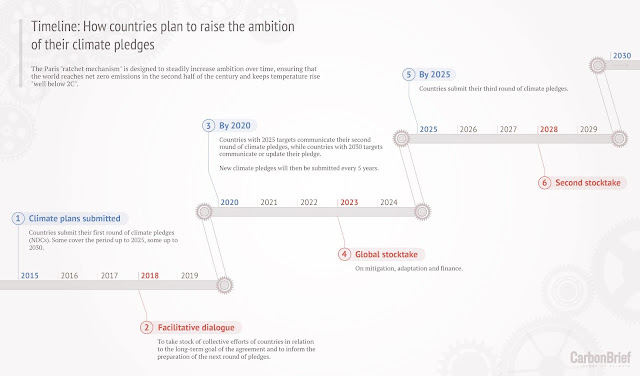
Ratchet Mechanism

The Paris Ratchat Mechanism is designed to steady increase ambition over the time , Ensuring that world reaches net zero emission in the second half of the century and keeps temperature 'well below 2 C '.


Stage one: NDCs 1.0
Even though the agreement has not yet come into force, this cyclical process is already underway.
In the nine months before Paris, countries submitted their “intended nationally determined contributions”, which are regularly abbreviated to INDCs.
Each of these contains the country’s intended domestic target for reducing or slowing its greenhouse gas emissions. Others contained information on topics, such as adaptation, loss and damage and financial need, according to individual preference.
The 160 submissions received by the UN remain “intended”, and are not set in stone until the country in question ratifies the agreement. Indeed, many countries stressed that their contribution was contingent upon the outcome of the UN deal struck in Paris.
Countries are not legally bound to meet the targets in their nationally determined contribution (NDC), but they must take action “with the aim of achieving” their goals.
However, the current policies do not collectively achieve the agreement’s aim to keep temperature rise to below 2C — and are even further from its aspirational target of limiting it to 1.5C.
Stage two: Facilitative dialogue
The ratcheting up of ambition really begins in 2018, when countries have agreed to convene a “facilitative dialogue”.
This is a chance for countries to take stock of how close they are to achieving the long-term goals of the agreement to peak emissions as soon as possible and achieve net zero emissions in the second half of the century.
This dialogue is designed to inform the next round of NDCs, so that countries have a clearer idea of the direction of travel.
Stage three: NDCs 2.0
With the outcome of the facilitative dialogue in mind, countries have to either update or communicate a new NDC by 2020.
Due to the flimsy set of rules guiding the first round of NDCs, the submissions cover various timeframes. Some set a target for 2030, such as the EU. Others have a target for 2025, such as the US.
For countries with a target covering the period up to 2025, they must communicate a new NDC by 2020. For those with 2030 targets, they must “communicate or update” these by 2020.
The agreement says that the efforts of each country will “represent a progression over time”, and reflect its “highest possible ambition”. For developed countries, these should be economy-wide, absolute emission targets, while developing countries are encouraged to move towards this kind of target over time. The division between developed and developing countries is now more fluid than it was before the agreement.
This does not mean that the ambition contained within each country’s current NDC is frozen in place. The agreement says that a country can adjust its contribution “at any time…with a view to enhancing its level of ambition” — but there is no strict obligation to undertake such improvements.
Once the agreement has come into force, countries will agree a common timeframe for their future contributions. This means that future cycles will eventually fall into line, with every country setting targets covering the same time period.
Countries must thereafter continue to submit new NDCs every five years. Alongside these, they are also encouraged to submit an “adaptation communication”, which includes its priorities, plans and needs. Every two years, developed countries also have to communicate how much climate finance they will provide to developing countries.
Stage four: Global stocktake
In 2023, just before the third round of NDCs are due to be submitted, the UN has agreed there will be a “global stocktake”.

Monday, 12 February 2018

Three new eel species found in Bay of Bengal

Scientists have discovered three new species of eel along the northern Bay of Bengal coast in the past few months. Dark brown with white dots on the dorsal side, Gymnothorax pseudotile was discovered at the Digha coast of the Bay of Bengal. 

The other two species, Gymnothorax visakhaensis (uniformly brown) and Enchelycore propinqua (reddish brown body mottled with irregular creamy white spots), were discovered from the Visakhapatnam coast of the Bay of Bengal. While Gymnothorax pseudotile is about 1 feet to 1.5 feet long, Gymnothorax visakhaensis is about a foot long. Enchelycore propinqua is the smallest of them measuring less than a foot. 

A description of all the three new species was published in the journal Zootaxa. Anil Mohapatra, a Zoological Survey of India ( ZSI) scientist who is behind all the three discoveries, said that while the specimens of the first two species can be found upon a considerable search, the third one is relatively rare. Scientists and researchers David G. Smith, Subhrendu Sekhar Mishra , Swarup Ranjan Mohanty, Dipanjan Ray and Prasad C. Tudu have contributed to these discoveries. 

Eels are found mostly at the bottom of rivers and seas. Across the world about 1,000 species of eels have been identied. In India, the number is around 125. For species belonging to the family Muraenidae, referred commonly as Moray eels, there are records of about 200 species of which more than 30 species are found in India. Five new species With these new discoveries, the Bay of Bengal coast has yielded at least five new species of eel. In 2016, Mr. Mohapatra and his team identied Gymnothorax indicus, an edible species.

 In 2015, a short brown unpatterned moray eel, named Gymnothorax mishrai (Bengal moray eel), was discovered from the coast of Bay of Bengal. The specimens of Gymnothorax pseudotile were collected in a trawl net by shermen in the northern Bay of Bengal.

Thursday, 4 January 2018

Scientists identify four new balsam species

Throwing fresh light on the uncharted biodiversity in India’s north­eastern region, researchers from the University of Calicut in Kerala have reported the discovery of four new species of balsam from various locations in Arunachal Pradesh.  The team came across the new species while scouring the Eastern Himalayas as part of an expedition supported by the Department of Science and Technology and the International Association for Plant Taxonomy, Slovakia. Commonly known as jewel weeds because of the diverse colour of the owers, balsams are distributed throughout the Eastern Himalayas and the Western Ghats, Sri Lanka, South East Asia, Africa and Madagascar. The genus is called  Impatiens, signifying the impatient nature of the fruits which explode when touched. The researchers have published their ndings in the international journals Phytotaxa and Webbia.  Reported from Pongchan, Impatiens haridasanii was named after Haridasan, former scientist, State Forest Research Institute, Arunachal Pradesh, for his contribution to the taxonomy of the north­eastern States. The species is characterised by small yellow owers and hairy leaves. Impatiens pseudocitrina, discovered in Anjaw district, sports bright yellow owers with small red spots on the throat and a long spur at the back. The species name denotes the similarities with I. citrina. A magnicent species discovered from the Lower Dibang valley, Impatiens nilalohitae grows to a height of more than one metre and has dark purple owers with pale yellow throat and green stalk. The name  nilalohitae denotes the dark purple colour in Sanskrit.  Another spectacular balsam, I. roingensis, was found growing in Roing and Upper Siang. The plant has clustered white owers with yellow patch on the mouth and hooked spur.  According to the authors, road widening works, deforestation and other development activities are posing a threat to the natural habitat of the new species.  The researchers have also reported the rediscovery of another species  I. agastyamalayensis from the Western Ghats after a gap of more than a century.  India is home to more than 230 balsam species.  Earlier, scientists had reported the discovery of Impatiens arunachalensis, a critically endangered species, from the Upper Siang district. Another balsam species Impatiens walongensis has been reported from Anjaw district.  

Monday, 1 January 2018

2 new ginger species found in the northeast 

Scientists have discovered two new species of ginger in easternmost districts, Ukhrul in Manipur and Tuensang in Nagaland, both bordering Myanmar. Hedychium chingmeianum, the species discovered in Tuensang district, is an epiphytic plant and grows on tall trees, while  Caulokaempferia dinabandhuensis was found growing in rock crevices, boulders and humus rich soil in the Shirui Hills, where the highest peak stands at an elevation of 2,938 metres. 

 Both the plants are from the family of Zingiberaceae, to which the commonly found ginger (Zingiber ocinale) belongs.

 Two Botanical Survey of India (BSI) scientists, Nripemo Odyou and Dilip Kumar Roy, found the plant  Hedychium chingmeianum, growing on tree trunks at Chingmei village in Tuensang district. 

The plant, with reddish stems and creamy white owers, was brought to the regional centre of BSI, Shillong, and cultivated there.  Paper published A paper on the discovery was published earlier this year in Telopea, an international Journal of Plant Systematics. “Most of the species under the genus  Hedychium have medicinal properties. 

It is yet to be ascertained whether the newly discovered species  Hedychium chingmeianum has medicinal properties or not,” Mr. Odyou told The Hindu. He said that out of 44 taxa, 31 species and 13 varieties of genus  Hedychium found in India, only five are reported in south India. 

The remaining species are all found in the northeast. The species Caulokaempferia dinabandhuensis was discovered by Biseshwori Thongam and Bipin Konsam of the Institute of Bioresources and Sustainable Development. The species has beautiful oval­ shaped pink owers which appear in June ­July. 

It was during a trip to Ukhrul hills that Dinabandhu Sahoo, director of the IBSD, spotted this species.  

The scientists named the species after Mr. Dinabandhu Sahoo

New night frog species found in western Ghats

Nyctibatrachus mewasinghi was discovered in the Western Ghats

A new frog from Kerala is the latest contribution to the spurt in amphibian discoveries across India: scientists have just discovered the Mewa Singh’s night frog, belonging to a genus endemic to the Western Ghats, from Kozhikode’s Malabar Wildlife Sanctuary.

  According to a scientific paper published on December 26 in  The Journal of Threatened Taxa (an international journal on conservation and taxonomy), the new night frog  Nyctibatrachus mewasinghi is light brown in colour with an o­ white underside, and sports faintly wrinkled skin with prominent granular projections. 

 Since many frogs in the genus  Nyctibatrachus look similar, scientists from institutes, including the Indian Institute of Science Education and Research (Pune, Maharashtra) and the Zoo Outreach Organisation (ZOO, Coimbatore, Tamil Nadu) used both physical characteristics as well as genetic methods to conrm the frog as a new species.  Using tissue samples of 10 collected specimens, the scientists analysed portions of two genes and found that it varied enough from other closely ­related species to make the Mewa Singh’s night frog a different species. 

They also found that the frog’s genetically closest relatives are the Athirappilly night frog (found south of the Palakkad Gap in Thrissur and Idukki) and the Kempholey night frog (found in the northern Western Ghats of Kerala and Karnataka). ‘Interesting species’ Morphologically, the Mewa Singh’s night frog can be distinguished from these similar ­looking and genetically close relatives by several physical characteristics, including the pattern of its webbed fingers and toes. 

The frog has been named after wildlife scientist Mewa Singh, in honour of his contributions to behavioural ecology and primate studies. The new frog is currently known only from Peruvannamuzhi in the Malabar Wildlife Sanctuary, where the scientists found it in a small stream running along the Peruvannamuzhi dam.

  “It is an interesting species because of this currently­ known restricted distribution,” says author Sanjay Molur of ZOO. What is unusual is that the frog’s genetically closest relative — the Athirappilly night frog — is found far away and across the Palakkad gap, says Mr. Molur. “Hence the species is also unique from a genetic perspective,” he says.  Frogs in the genus Nyctibatrachus, commonly known as night frogs, are found only in the Western Ghats mountain range. 

The addition of the Mewa Singh’s night frog to this group brings the total number of night frogs to 36

Sunday, 31 December 2017

New endemic ants from the Andamans

There's more to the Andamans than magical beaches and colourful corals. Scientists have discovered two new ant species of the genus Tetramorium in the evergreen forests of the archipelago. 

 Scientists of the National Centre for Biological Sciences (NCBS), Bengaluru and the Okinawa Institute of Science and Technology Graduate University, Japan have discovered the new species Tetramorium krishnani and Tetramorium jarawa during a detailed island ­wide survey of Havelock Island, a part of the Andaman archipelago. 

The species are named in honour of late scientist K.S. Krishnan of the NCBS, and after the Jarawas, an indigenous people of the islands, who are thought to have inhabited the islands for at least several thousand years. 

 The newly discovered ants dwell in leaf litter in the evergreen forests of Havelock Island and are endemic to the Andamans. 

In total, the study recorded the presence of 50 ant species, many of which have been recorded for the first time. The study published in Peer J also provides accounts of all Tetramorium ant species seen in India and an illustrated identication 'key' for these Indian species, which allows ant enthusiasts to use the distinct features of an ant to identify what species it belongs to. In a first for India, the team used a novel X­ ray micro CT technology to build 3D models of the ant specimens to observe anatomical structures in detail for easier taxonomic identification of the species. These 3D images can be mapped with the genetic profiles of species using the new technology to study the evolution of ant morphology. 

 “We are excited about the discovery, though we did expect to come across new species because we know very little about India's ant species, they are not well­ documented,” says Gaurav Agavekar, one of the authors. “I hope to sample other islands of the archipelago in future, as well as mainland India to generate quality baseline data for ants across the country, which can be used to answer interesting ecological and evolutionary questions.”

Friday, 22 December 2017

2017 may be among top 3 hottest years

The year 2017 will likely be among the three warmest years on global record, according to the World Meteorological Organization (WMO). 

The first 11 months of 2017 were the third warmest on record, behind 2016 and 2015, with much­warmer than­ average conditions engulfing much of the world’s land and ocean surfaces, researchers said. 

Arctic and Antarctic sea ice coverage remain at near record lows. 2017 may also be the warmest year without an El Nino — a climate phenomenon that causes global temperatures to shoot up. 

Data from NASA and the European Centre for Medium Range Weather Forecasts (ECMWF) shows that the past meteorological year (December 2016 to November 2017) is the second warmest on record.

 “What is more important than the ranking of an individual year is the overall, long term trend of warming since the late 1970s, and especially this century,” said Omar Baddour, senior scientist at WMO. 

Socio-economic impact “Along with rising temperatures, we are seeing more extreme weather with huge socio­ economic impacts,” Mr. Baddour said. 

WMO will combine data sets from U.S. National Oceanic and Atmospheric Administration (NOAA), NASA’s Goddard Institute for Space Studies (GISS), and the Met Oce Hadley Centre and Climatic Research Unit in the U.K. for a consolidated temperature ranking for 2017. 

According to NOAA, the month of November was the fth warmest on record, whilst NASA and ECMWF Copernicus Climate Change Service both said it was the third warmest. 

During November 2017, warmer­ than ­average temperatures dominated across much of the world’s land and ocean surfaces, with the most notable temperature departures from average across the Northern Hemisphere. 

Parts of the western contiguous U.S., northern Canada, northern and western Alaska, western Asia and far eastern Russia had temperature departures from average that were 2.0 degrees Celsius or greater, according to NOAA. 

As an indication of swift regional climate change in and near the Arctic, the average temperature observed at the weather station has now changed so rapidly that it triggered an algorithm designed to detect artificial changes in a station’s instrumentation or environment and disqualifyed itself from the NCEI Alaskan temperature analysis. 

The omission was noticed by the National Centers for Environmental Information (NCEI), which realized that data from Reykjavik, Alaska had been missing for all of 2017 and the last few months of 2016.

Sunday, 3 December 2017

Biosphere reserves in India

What is the Biosphere Reserve?

  • ‘Biosphere Reserves’ are designated natural sites, comprising terrestrial or marine or coastal or combined ecosystems, which promote the conservation of biodiversity and minimizes the conflict between the development and nature conservation.
  • ‘Biosphere Reserve’ is originally an international concept. It was introduced by International Co-ordinating Council (ICC) of UNESCO in Nov.1971 for the first time.

Criteria of the Biosphere Reserve


  • A site must contain protected and minimally disturbed core area of value of nature conservation.
  • Core zone should be large enough to sustain viable populations representing all Tropic levels in the ecosystem.
  • Management authorities to ensure local community involvement to bring the variety of knowledge and experiences to link biodiversity conservation and socio-economic development while managing and containing the conflicts.
  • Areas potential for preservation of traditional tribal or rural modes of living for harmonious use of the environment.

Structure of the Biosphere Reserve

Biosphere reserves are demarcated into following three zones.

1. Core Zone

  • This zone is the heart and soul of the Biosphere Reserve.
  • The core contains the maximum diversity of numerous plants and animals which are endemic to the region.
  • Most of the times, Core part is the legally protected area like the National park, sanctuaries under Wildlife Protection Act 1972.
  • Management and research activities are allowed to some extent without affecting ecological diversity and wildlife.
  • Activities like grazing, human settlement are not allowed in the core zone. So it is always free from human encroachment.

2. Buffer Zone

  • Buffer zone surrounds core zone. It acts like the blanket to the core part.
  • In Buffer zone, some activities like Grazing, fishing, research, tourism are allowed under strict regulations without affecting ecological diversity.

3. Transition Zone

  • This zone is the outermost cover of the biosphere reserve.
  • This zone contains least diversity and density of animal and trees.
  • It is an example of ‘Human- Nature Coexistence’.
  • This zone includes human settlements, agriculture, forests etc.

Functions of Biosphere Reserve

  • There are tripartite i.e. three main functions of the biosphere reserve given follow
  1. Conservation
  • Conservation of diversity and integrity of plants and animals within natural ecosystems
  1. Development
  • Sustainable use of natural resources for the Cultural, Social, Economic development of local community
  1. Logistics Support
  • Provide areas and facilities for multi-faceted research and monitoring

List of Biospheres in India

  • Currently, there are 18 notified biosphere reserves in India.
  • The list of Biosphere Reserves in India notified chronologically, is given below.
  1. Nilgiri Biosphere
  • This is the first Biosphere of India notified in 1986.
  • This spreads over three states Tamil Nadu, Karnataka and Kerala.
  1. Nanda Devi
  • This lies in Uttarakhand state.
  1. Nokrek
  • This biosphere lies in the Garo hills of Meghalaya state.
  1. Great Nicobar
  • This is the only biosphere reserve in India that entirely lies in the Union territory i.e. Andaman and Nicobar
  1. Gulf of Mannar
  • It lies in the Indian part of Gulf of Mannar between India and Sri Lanka i.e. in Tamil Nadu state.
  1. Manas
  • It spreads over part of Kokrajhar, Barpeta, Nalbari districts of Assam.
  1. Sundarban
  • It lies in part of delta system of Ganges and Brahmaputra rivers in West Bengal state.
  1. Simplipal
  • It lies in part of Mayurbhanj district of Orissa state.
  1. Dibru-Saikhowa
  • It spreads over Dibrugarh and Tinsukhia districts of Assam.
  1. Dehang- Dibang
  • It spreads over part of Siang and Dibang Valley in Arunachal Pradesh state.
  1. Pachmarhi
  • It lies in central India in the state of Madhya Pradesh.
  1. Khangchendzonga
  • It is part of Sikkim state and it is the only mixed heritage site in UNESCO’s world heritage sites list.
  1. Agasthyamalai
  • It spreads over eastern part of Kerala state.
  • Neyyar, Peppara and Shendurney wildlife sanctuaries are part of this biosphere.
  1. Achanakamar- Amarkantak
  • It spreads over Dindori, Anupur districts of Madhya Pradesh and Bilaspur districts of Chhattisgarh state.
  1. Kachchh
  • It lies in the desert area of Gujarat state.
  1. Cold Desert
  • It spreads over Himachal Pradesh state. Pin Valley National Park and surroundings, Chandratal and Sarchu & Kibber wildlife sanctuaries are part of this biosphere.
  1. Seshachalam Hills
  • It lies in the Andhra Pradesh district.
  1. Panna
  • It is the latest added biosphere in 2011.
  • It lies in Madhya Pradesh state.


Out of these 18 biosphere reserves from India, there are 10 biosphere reserves which are internationally recognised under World Network of Biosphere Reserves (WNBR) of the Man and Biosphere (MAB) programme of UNESCO.

Man And Biosphere (MAB) Programme

  • MAB programme was launched in 1971.
  • It is an intergovernmental scientific programme that aims to establish a scientific basis for the improvement of relationships between nature and human.
  • Biosphere Reserves are nominated by the national government for inclusion in the world network of biospheres.
  • Then the committee of MAB programme recognises the BRs after fulfilling the criteria.
  • There are currently 669 sites in 120 countries in World Network of Biosphere Reserves (WNBR) of the Man and Biosphere (MAB) programme.
  • Out of these, 10 BRs are from India.

List of Biosphere reserves in MAB Programme

  1. Nilgiri Biosphere- Oldest entry from India in the list in 2000
  2. Gulf of Mannar
  3. Sundarban
  4. Nanda Devi
  5. Nokrek
  6. Simplipal
  7. Pachmarhi
  8. Achanakamar- Amarkantak
  9. Great Nicobar
  10. Agasthyamalai- Latest entry from India in the list in 2016

Sunday, 26 November 2017

New identity  Dutta’s Mahendragiri gecko for an Eastern Ghats resident

For the last 70 years, it did not get its rightful place in the classication scheme. But the Dutta’s Mahendragiri gecko has come into its own now, and is the latest addition to the species list of the Eastern Ghats. 

Discovered from Andhra Pradesh’s Mahendragiri hills, it is the second gecko to be found endemic to the area. 


The discovery highlights the biodiversity importance of the region, say scientists. Genetics help Genetic analysis, which involves scrutiny of an organism’s DNA, helped scientists from institutes including the National Centre for Biological Sciences (NCBS) and Zoological Survey of India discover that the Dutta’s Mahendragiri geckos were not a population of Spotted rock geckos (found in the northern Western Ghats in Maharashtra) as it was believed. 

“DNA sequence data showed that these two geographically ­separated populations are different and a careful examination of their characteristics showed that the new species has many unique, diagnostic characters,” says Varad Giri (NCBS), lead author of the six­ year long study published in the journal Zootaxa. 

 Dutta’s Mahendragiri gecko has golden eyes and pale, black­ bordered horizontal bands. Christened Hemidactylus sushil duttai in honour of herpetologist Sushil Kumar Dutta, the lizard is the 32nd species of Hemidactylus gecko found in India.

Sunday, 19 November 2017

New Parasitic plant (Gleadovia konyakianorum) found in Nagaland

Parasitic plant found in Nagaland has no chlorophyll of its own, survives by stealing food from its host

Scientists have discovered a new species of parasitic flowering plant that has no chlorophyll, and survives by feeding on another species of plant that does (chlorophyll helps a plant make its own food using sunlight). 

 The species, named Gleadovia konyakianorum, in honour of the Konyak tribe of Nagas, was identified during an exploration earlier this year near Tobu town of Mon district in eastern Nagaland. 

“It is a holoparasite [complete parasite] that derives its entire nutritional requirement from the host plant, which is a Strobilanthes species. 

The plant was found in the semi evergreen forest at an altitude of 1,500­1,600 metres,” said Dilip Kumar Roy, a scientist with the Botanical Survey of India (BSI). 

Along with Mr. Roy, two others – N Odoyo, also from the BSI, and a Russian scientist, Leonid V. Averyanov – published the details of the new species in the journal Phytotaxa. 

Though it has no chlorophyll, the plant has a vascular system and extracts its nutrition from the host plant with the help of a haustorium, the scientists said. 


A haustorium is a specialised structure with which plant parasites attach themselves to the host plants and derive nutrition. Gleadovia konyakianorum is a root parasite that grows up to 10 cm in height, and bears white, tubular flowers. 

Interestingly, this is only the fourth species from the genus Gleadovia to be found in the world. 

The other three are Gleadovia banerjiana (discovered in Manipur), Gleadovia mupinense (found in China) and Gleadovia ruborum (discovered in Uttarakhand and also reported from China). 

The white flowering parasite was found in a group of 15­20 plants, and since the species hasn’t been reported elsewhere, scientists have described its status as ‘data deficient’ as per International Union for Conservation of Nature (IUCN) Red List of Threatened Species criteria. “Parasitic plants are often referred to as curious plants, as they steal their nutritional needs from the host. 

Not only are they rare, they are crucial links in the plant kingdom that attest to Darwin’s theory of survival of the fittest,” said Rajib Gogoi, a scientist from BSI’s central national herbarium. 

Plant parasites can be stem or root parasites. Common stem parasites in India are Loranthus sp, on Mango trees, and Cuscuta reflexa, a climber. Among root parasites are Sapria himalayana, found in Arunachal Pradesh and Meghalaya.

Monday, 13 November 2017

New orangutan species in Sumatra

Scientists have discovered a new species of orangutan in the Indonesian island of Sumatra, but have also concurrently warned that it is in severe danger of going extinct. 

Present in extremely small numbers, and faced with a fractured and damaged habitat, the primates, named Pongo tapanuliensis, number no more than 800, and scientists claim it is the most endangered great ape species in the world. The study, published in the journal Current Biology added that if steps are not taken to conserve the remaining forest land in the area, the species may be wiped out in our lifetimes. It is the first species of great ape to be discovered in nearly 90 years.

Bonnet macaques losing their ground in south India

It’s tough times for south India's bonnet macaques — a monkey that we think is irritatingly common could be losing ground to the larger and more aggressive rhesus macaque of the north. 

Other factors contributing to their decline include rapid urbanisation (as roadside trees are felled and vegetation lost) and their disappearance from temples and tourist spots, says a study published in PLOS ONE. 

Bonnet macaques are endemic commensals: they are found only in peninsular India and live in close proximity with humans, adapting to habitats ranging from riverside temples to roadside fig trees.

 However, a study in 2011 suggested that rhesus macaques were invading the bonnet’s habitats in south India. 

Surveys To assess the current status of bonnet macaques, a team of scientists from institutes including Tamil Nadu’s Salim Ali Centre for Ornithology and Natural History (SACON) surveyed roadsides (1,140 km in total) in peninsular India which were considered the southernmost boundary for rhesus macaques and compiled distributional data from earlier studies in the area. 

They found that rhesus macaques have spread as far south as Karnataka’s Raichur district — adding 24,565 sq km to their former range — in an area where bonnet macaques used to reside. 

The team collated information on bonnet macaque presence from surveys between 1989 and 2015 along 651 km of Mysore's roadsides and found that over the last 25 years a staggering 65% of the population has disappeared. 

The scientists predict that many of these populations will go locally extinct in 10 years. High resolution satellite and Google Earth imagery between 2000 and 2006 and from 2015 on wards showed a decrease in tree cover on and around these roads; the loss of contiguous canopies now prevents the monkeys from colonising new areas. 

Vanishing numbers Bonnet macaques were present only in low numbers across 16 forest-dominated protected areas that the team surveyed in south India. 

They also found that bonnet macaques have disappeared from more than 48% of temples and tourist spots across Kerala, Karnataka and Tamil Nadu. 

These areas are no longer stable habitats for these monkeys, write the scientists. “People are now less tolerant to bonnet macaques,” says co-author H. N. Kumara, senior scientist at SACON. “Even in temples, they are captured and translocated elsewhere. 

If we can give them a little space, they will survive. We need to take more interest in these common and less-charismatic species before they decline like sparrows did.”

Wednesday, 8 November 2017

New ant species found in the Western Ghats

Researchers have discovered a new species of ant in the Western Ghats. It has been found in the Periyar Tiger Reserve. 

The research, published in journal Zootaxa, has been undertaken by Kalesh Sadasivan and Manoj Kripakaran, members of the non-governmental organisation Travancore Natural History Society’s Ant Research Group. Belonging to Tyrannomyrmex, a rare tropical genus of ants, the species was discovered by the team from the Vallakadavu range a year ago. 

Paying tribute to their mentor and eminent myrmecologist Musthak Ali, who is regarded as the country’s ‘ant man’, the authors of the study have named the new species Tyrannomyrmex alii (or T. alii) Sadasivan and Kripakaran 2017. 

According to Dr. Sadasivan, Tyrannomyrmex is a rare myrmicine ant genus that is distributed in the Indomalayan bioregion that extends from southern India and Sri Lanka to southeast Asia. 

Edible wild banana species discovered, the second such on the island in two years

Botanists in the Andaman and Nicobar Islands have been quietly going bananas. And it is not their fault, for the islands are a biodiversity hotspot that hosts seven different species of wild banana that we know of, not to mention numerous, as yet undocumented, others. 

The latest discovery, published in the Nordic Journal of Botany, is of a species of wild banana named Musa paramjitiana, in honour of Paramjit Singh, who happens to be the director of the Botanical Survey of India (BSI).

 The species was found in North Andaman’s Krishnapuri forest, 6 kilometres from any human habitation. The plant grows to a height of nine metres and bears an edible, sweet-andsour tasting fruit that is boat-shaped and has numerous bulb-shaped seeds. 

Its conservation status has been declared as ‘Critically Endangered’ as it has so far been spotted in only two locations on the islands, each with 6 to 18 plants in a clump. “No population has been located in the other regions of the Andaman Islands, and the drastic disappearance of its mixed forest habitat indicates that the species should be considered Critically Endangered, based on IUCN Red List categories and criteria,” observed the article by Lal Ji Singh, a BSI scientist. 

According to Mr. Singh, the fruit is part of the diet of local tribes. “The fruits and seeds have ethno-medicinal importance. Pseudo-stem and leaves of these species are also used during religious and cultural ceremonies,” he added. Conserve germplasm “These discoveries present a great opportunity for plant breeders and horticulture experts to improve the existing banana crop. 

The germplasm of all the wild banana species needs to be conserved on an urgent basis, since most of these are found in very small habitats and at risk of extinction,” Mr. Singh said. In 2014, he discovered Musa indandamanensis, another wild banana, in a remote tropical rain forest on the Little Andaman island. It has dark green cylindrical flower buds.

Tuesday, 7 November 2017

2017 is set to be in top three hottest years: WMO

All-India rainfall for the 2017 monsoon season was 5% below average, the statement says


2017 will be one of the three hottest years on record, with many high-impact events including catastrophic hurricanes and floods, debilitating heat waves and drought, a provisional statement on the State of the Climate released by the World Meteorological Organization (WMO) has said. 

The average global temperature from January to September 2017 was approximately 1.1°C above the pre-industrial era. Powerful El Nino As a result of a powerful El Niño, 2016 is likely to remain the warmest year on record, with 2017 and 2015 being second or third. 

The WMO statement, which uses 1981-2010 as the baseline, was released on Monday at the opening day of the United Nations climate change conference in Bonn. “The past three years have all been in the top three years in terms of temperature records. 

This is part of a long term warming trend,” said WMO SecretaryGeneral Petteri Taalas, in a release. “We have witnessed extraordinary weather, including temperatures topping 50 degrees Celsius in Asia, record-breaking hurricanes in rapid succession in the Caribbean and Atlantic reaching as far as Ireland, devastating monsoon flooding affecting many millions of people and a relentless drought in East Africa,” Mr. Taalas added. 

Extreme weather events due to climate change have affected the food security of millions of people with agriculture accounting for 26% of all the damage and loss associated with medium to large-scale storms, floods and drought, the statement said, citing an FAO assessment. 

Flooding in Northeast All-India rainfall for the 2017 monsoon season (June to September) was 5% below average. However, aboveaverage rainfall in the Northeast and adjacent countries led to significant flooding. Many parts of the Indian subcontinent were affected by monsoonal flooding, the statement said. 

Wednesday, 27 September 2017

'Carbon Positive' ‘carbon zero’, ‘carbon neutral’, ‘zero energy’ or ‘zero emission’

  • The terms ‘carbon zero’, ‘carbon neutral’, ‘zero energy’ or ‘zero emission’ apply to buildings that use renewable energy sources on site to generate energy for their operation, so that over a year the net amount of energy generated on site equals the net amount of energy required by the building.
  • Carbon positive moves beyond carbon zero by making additional ‘positive’ or ‘net export’ contributions by producing more energy on site than the building requires and feeding it back to the grid.
  • Carbon positive projects can make significant contributions by helping to address the carbon intensity and damaging impacts of past building practices and lifestyles, and by offsetting situations where carbon zero homes are not possible.
  • Also in such areas carbon sequestration is more than carbon emissions and not just zero emissions.