Showing posts with label Syllabus Mains. Show all posts

Thursday, 31 August 2017

Most Important Books for Mains IAS Exam

  1. History Of Modern India – Bipan Chandra. (History)
  2. India’s Struggle For Independence – Bipan Chandra. (History)
  3. India’s Ancient Past – R.S. Sharma. (History)
  4. History Of Medieval India – Satish Chandra. (History)
  5. The Wonder That Was India – A.L. Bhasham. (Culture)
  6. Indian Art and Culture – Nitin Singhania. (Culture)
  7. Geography of India – Majid Husain. (Geography)
  8. Oxford School Atlas – Oxford. (Geography)
  9. Certificate Physical and Human Geography – Goh Cheng Leong. (Geography)
  10. Indian Polity for Civil Services Examinations – M. Laxmikanth. (Polity)
  11. Indian Economy – Ramesh Singh. (Economy)
  12. Economic Survey. (Economy)
  13. Science and Technology in India – TMH. (Science and Technology)
  14. Environmental Studies: From Crisis to Cure – Rajagopalan. (Environment)
  15. Environment for Civil Services Prelims and Mains – Khuller. (Environment)
  16. India Year Book (Current Affairs)
  17. Manorama Yearbook. (Current Affairs)
  18. CSAT Paper – 2 Manual by TMH or CSAT-II – Arihant (CSAT – Paper 2)
  19. Analytical Reasoning – M. K. Pandey (CSAT – Paper 2: Analytical Reasoning)
  20. Verbal & Non-Verbal Reasoning – R. S.Aggarwal (CSAT Paper 2: Reasoning)

Additional IAS Books for UPSC Mains (Click on the links to buy online)


  1. Essays for Civil Services – Pulkit Khare (Essay Paper)
  2. India After Gandhi – Ramchandra Guha (History – GS1)
  3. Norman Lowe OR History of Modern World – Jain and Mathur (World History – GS1)
  4. Social Problems In India – Ram Ahuja. (Indian Society – GS1)
  5. IAS Mains General Studies Paper 2 (Arihant Manual – GS2)
  6. Governance in India for CSE. (Governance – GS2)
  7. Pax Indica – Shashi Tharoor. (Foreign Policy – GS2)
  8. India and the World by Surendra Kumar. (Foreign Policy – GS2)
  9. IAS Mains General Studies – GS3. (Arihant Manual – GS3)
  10. India’s National Security: A Reader. (Internal Security – GS3)
  11. Challenges to Internal Security of India. (Internal Security – GS3)
  12. Lexicon for Ethics, Integrity, and Aptitude. ( Ethics – GS4)
  13. IAS Mains General Studies – Ethics. ( Arihant Manual – GS4)
PS: Many books for UPSC Civil Service Main Exam overlap with books recommended for Prelims, except the mentioned additional books for topics like Foreign Relations, Internal Security, Ethics etc.
IAS Books for Optional Subjects and Additional Reference 

Friday, 28 April 2017

What is India's Twin Balance Sheet Problem and How to tackled ?

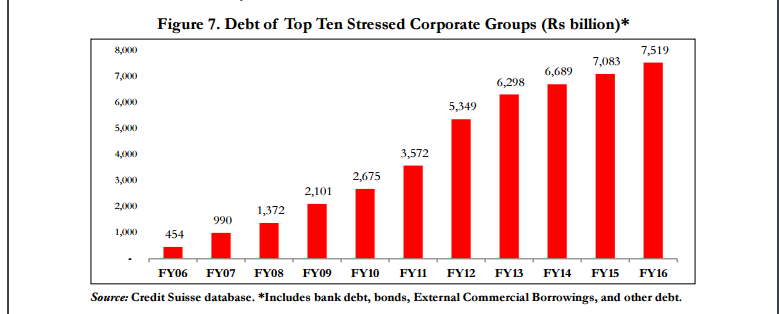
India's twin balance sheet problem is unique mix of over leveraged and distressed companies and one hand and rising NPAs in bank on the other. Twin balance sheet has held up investment and has decelerated India's growth wagon wheel.

Causes of twin balance sheet Problem


the Genesis of twin balance sheet can be found in the early 2000s when the Indian Economy was consistently growing at rate of 8 % the factor leading to rising bank NPA and over leveraged companies are 

  1. Bank lend aggressively when the market and Economy was in Good position.

  2.  Poor regulation and lack of period checks on the profitability and sustainability of the companies and their projects.

  3.  Project bid extremely low tariff with confidence to renew them later but which didn't happened.

  4. Project delayed due to lack of environmental clearance , growing cost of raw material.

  5. To resolve the delay in project , bank resorted to ever greening of loans .


Step to be taken

  1. Loss recognition. 

  • The AQR was meant to force banks to recognise the true state of their balance sheets. But banks nonetheless continue to evergreen loans, as the substantial estimates of unrecognised stressed assets make clear.

    2. Coordination. 

  • The RBI has encouraged creditors to come together in Joint Lenders Forums, where decisions can be taken by 75 percent of creditors by value and 60 percent by number. But reaching agreement in these Forums has proved difficult, because different banks have different degrees of credit exposure, capital cushions, and incentives. For example, banks with relatively large exposures may be much more reluctant to accept losses. In some cases the firm’s losses aren’t even known, for they depend on the extent of government compensation for its own implementation shortfalls, such as delays in acquiring land or adjusting electricity tariffs. And deciding compensation is a difficult and time-consuming task; many cases are now with the judiciary. 

    3. Proper incentives. 

  • The S4A scheme recognises that large debt reductions will be needed to restore viability in many cases. But public sector bankers are reluctant to grant write-downs, because there are no rewards for doing so. To the contrary, there is an inherent threat of punishment, since major write-downs can attract the attention of investigative agencies. Accordingly, bankers have every incentive to simply reschedule loans, in orderto deferthe problems until a later date. To address this problem, the Bank Board Bureau (BBB) has created an Oversight Committee which can vet and certify write-down proposals. But it remains open whether it can change bankers’ incentives.

    4. Capital. 

  • The government has promised under the Indradhanush scheme to infuse Rs 70,000 crores of capital into the public sector banks by 2018-19. But this is far from sufficient, and inherently so, because there is a principal-agent problem, arising from the separation of the institution with financial responsibility (the government) from its decision-making agent (the state banks). If the government promises unduly large funds in advance, the banks may grant excessive debt reductions. But banks do not receive sufficient assurance of funding, they will not be able to grant companies enough debt relief.

Challenges


  1. difficult to dispose the Assets
  2. Market over capacity in some sector make more difficult to dispose i.e Steel
  3.  It will be very difficult to recover from service sector and intangible asset 
  4. Govt. and stake holder (bank) may have incur losses due to undervaluation of  assets.


Thursday, 23 February 2017

General Studies- IV: Ethics, Integrity and Aptitude

General Studies- TV: Ethics, Integrity and Aptitude


This paper will include questions to test the candidates’ attitude and approach to issues relating to integrity, probity in public life and his problem solving approach to various issues and conflicts faced by him in dealing with society. Questions may utilise the case study approach to determine these aspects. The following broad areas will be covered :
  • Ethics and Human Interface: Essence, determinants and consequences of Ethics in-human actions; dimensions of ethics; ethics - in private and public relationships. Human Values - lessons from the lives and teachings of great leaders, reformers and administrators; role of family society and educational institutions in inculcating values.
  • Attitude: content, structure, function; its influence and relation with thought and behaviour; moral and political attitudes; social influence and persuasion.
  • Aptitude and foundation values for Civil Service, integrity, impartiality and non-partisanship, objectivity, dedication to public service, empathy, tolerance and compassion towards the weaker-sections.
  • Emotional intelligence-concepts, and their utilities and application in administration and governance.
  • Contributions of moral thinkers and philosophers from India and world.
  • Public/Civil service values and Ethics in Public administration: Status and problems; ethical concerns and dilemmas in government and private institutions; laws, rules, regulations and conscience as sources of ethical guidance; accountability and ethical governance; strengthening of ethical and moral values in governance; ethical issues in international relations and funding; corporate governance.
  • Probity in Governance: Concept of public service; Philosophical basis of governance and probity; Information sharing and transparency in government, Right to Information, Codes of Ethics, Codes of Conduct, Citizen’s Charters, Work culture, Quality of service delivery, Utilization of public funds, challenges of corruption.
  • Case Studies on above issues. 

General Studies-III: Technology, Economic Development, Bio diversity, Environment, Security and Disaster Management

General Studies-III: Technology, Economic Development, Bio diversity, Environment, Security and Disaster Management

•       Indian Economy and issues relating to planning, mobilization, of resources, growth, development and employment.
•       Inclusive growth and issues arising from it.
•       Government Budgeting.
•       Major crops-cropping patterns in various parts of the country, - different types of irrigation and irrigation systems storage, transport and marketing of agricultural produce and issues and related constraints; e- technology in the aid of farmers.
•       Issues related to direct and indirect farm subsidies and minimum support prices; Public Distribution System- objectives, functioning, limitations, revamping; issues of buffer stocks and food security; Technology missions; economics of animal-rearing.
•       Food processing and related industries in India- scope’ and significance, location, upstream and downstream requirements, supply chain management.
•       Land reforms in India.
•       Effects of liberalization on the economy, changes in industrial policy and their effects on industrial growth.
•       Infrastructure: Energy, Ports, Roads, Airports, Railways etc.
•       Investment models.
•       Science and Technology- developments and their applications and effects in everyday life.
•       Achievements of Indians in science & technology; indigenization of technology and developing new technology.
•       Awareness in the fields of IT, Space, Computers, robotics, nano-technology, bio-technology and issues relating to intellectual property rights.
•       Conservation, environmental pollution and degradation, environmental impact assessment.
•       Disaster and disaster management.
•       Linkages between development and spread of extremism.
•       Role of external state and non-state actors in creating challenges to internal security.
•       Challenges to internal security through communication networks, role of media and social networking sites in internal security challenges, basics of cyber security; money-laundering and its prevention.
•       Security challenges and their management in border areas - linkages of organized crime with terrorism.

•       Various Security forces and agencies and their mandate.

General Studies- II: Governance, Constitution, Polity, Social Justice and International relations.

General Studies- II: Governance, Constitution, Polity, Social Justice and International relations.
•       Indian Constitution—historical underpinnings, evolution, features, amendments, significant provisions and basic structure.
•       Functions and responsibilities of the Union and the States, issues and challenges pertaining to the federal structure, devolution of powers and finances up to local levels and challenges therein.
•       Separation of powers between various organs dispute redressal mechanisms and institutions.
•       Comparison of the Indian constitutional scheme with that of other countries.
•       Parliament and State legislatures—structure, functioning, conduct of business, powers & privileges and issues arising out of these.
•       Structure, organization and functioning of the Executive and the Judiciary—Ministries and Departments of the Government; pressure groups and formal/informal associations and their role in the Polity.
•       Salient features of the Representation of People’s Act.
•       Appointment to various Constitutional posts, powers, functions and responsibilities of various Constitutional Bodies.
•       Statutory, regulatory and various quasi-judicial bodies.
•       Government policies and interventions for development in various sectors and issues arising out of their design and implementation.
•       Development processes and the development industry —the role of NGOs, SHGs, various groups and associations, donors, charities, institutional and other stakeholders.
•       Welfare schemes for vulnerable sections of the population by the Centre and States and the performance of these schemes; mechanisms, laws, institutions and Bodies constituted for the protection and betterment of these vulnerable sections.
•       Issues relating to development and management of Social Sector/Services relating to Health, Education, Human Resources.
•       Issues relating to poverty and hunger.
•       Important aspects of governance, transparency and accountability, e-governance- applications, models, successes, limitations, and potential; citizens charters, transparency & accountability and institutional and other measures.
•       Role of civil services in a democracy.
•       India and its neighborhood- relations.
•       Bilateral, regional and global groupings and agreements involving India and/or affecting India’s interests.
•       Effect of policies and politics of developed and developing countries on India’s interests, Indian diaspora.

•       Important International institutions, agencies and fora- their structure, mandate.


General Studies-I Indian Heritage and Culture, History and Geography of the World and Society.

General Studies-I

Syllabus (2017 UPSC Original)

General Studies-I : Indian Heritage and Culture, History and Geography of the World and Society.

  • Indian culture will cover the salient aspects of Art Forms, literature and Architecture from ancient to modern times.
  • Modern Indian history from about the middle of the eighteenth century until the present- significant events, personalities, issues.
  • The Freedom Struggle — its various stages and important contributors/contributions from different parts of the country.
  • Post-independence consolidation and reorganization within the country.
  • History of the world will include events from 18 th century such as industrial revolution, world wars, redrawal of national boundaries, colonization, decolonization, political philosophies like communism, capitalism, socialism etc.— their forms and effect on the society.
  • Salient features of Indian Society, Diversity of India.
  • Role of women and women’s organization, population and associated issues, poverty and developmental issues, urbanization, their problems and their remedies.
  • Effects of globalization on Indian society.
  • Social empowerment, communalism, regionalism & secularism.
  • Salient features of world’s physical geography.
  • Distribution of key natural resources across the world (including South Asia and the Indian sub-continent); factors responsible for the location of primary, secondary, and tertiary sector industries in various parts of the world (including India).
  • Important Geophysical phenomena such as earthquakes, Tsunami, Volcanic activity, cyclone etc., geographical features and their location-changes in critical geographical features (including water-bodies and ice-caps) and in flora and fauna and the effects of such changes